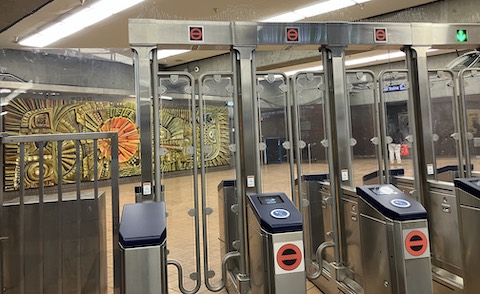
BART Richmond fare gates. (Danielle Parenteau-Decker / The CC Pulse)
By Bay City News
BART will raise fares by 6.2% on New Year’s Day, citing inflation and long-term financial pressures, even as ridership continues to climb across much of the transit system, the transit agency said.
The fare increase will lift the average ride by 30 cents, from $4.88 to $5.18, based on inflation recorded in 2023 and 2024. A short trip like Downtown Berkeley to 19th Street/Oakland station will rise by 15 cents, while longer journeys — including the 45-mile Antioch-to-Montgomery Street trip — will cost 55 cents more.
BART expects the increase to generate $15.6 million in 2026. Parking prices will also change on Jan. 1, though details were not specified.
RIDERSHIP SHOWS STEADY GAINS
The fare hike comes as ridership shows steady improvement. In November, the transit agency recorded an 11.6% rise in overall ridership from a year earlier, with riders taking more than 4.4 million trips, BART said. Growth was especially strong at many stations, including Downtown Berkeley station, where exits climbed nearly 20%, and 19th Street/Oakland and 12th Street/Oakland City Center stations, both of which saw increases of more than 20%. West Oakland and Embarcadero stations also posted gains of 24% and 17%, respectively.
Weekend and off-peak travel continue to drive the rebound. Saturday ridership jumped 19% in November compared with last year, while Sunday ridership rose 16%. Travel to San Francisco International Airport and Oakland International Airport around Thanksgiving increased 12%, BART said.
Transit officials said the gains reflect changing travel patterns, wider adoption of new fare programs, and improvements to safety and cleanliness. Crime on the system is down 45% as of October, according to BART, and customer satisfaction reached 88% in 2025.
New fare tools are also reshaping how riders pay, according to the transit agency. Tap and Ride, which allows riders to use contactless bank cards or mobile wallets at fare gates, accounted for 11% of all trips in November. Usage of Clipper BayPass surged 173% from a year earlier, while participation in the Clipper START low-income discount program increased 37%.
BUDGET DEFICIT
Despite the momentum, BART says ridership would need to more than double to close its budget gap through fares alone. The transit agency still projects a deficit of around $375 million, highlighting what its officials describe as an outdated funding model that relies heavily on passenger fares in an era of remote and hybrid work.
The transit agency’s most recent forecast projects only a 4% ridership increase in 2026, underscoring the limits of fare revenue as a solution.
“As we ask the region for greater investments and support for BART while also making internal cuts to reduce costs, we also must ask our riders to contribute more towards their trips,” BART Board President Mark Foley said in a statement released Friday.
BART has balanced its 2026 budget with $35 million in ongoing cuts and plans $108 million in additional savings and deferrals in 2027, including shorter trains to reduce energy costs, a hiring freeze, targeted operating cuts, renegotiated retiree health care costs, and long-term energy contracts.
We use cookies on our website to give you the most relevant experience by remembering your preferences and repeat visits. By clicking “Accept”, you consent to the use of ALL the cookies.
This website uses cookies to improve your experience while you navigate through the website. Out of these, the cookies that are categorized as necessary are stored on your browser as they are essential for the working of basic functionalities of the website. We also use third-party cookies that help us analyze and understand how you use this website. These cookies will be stored in your browser only with your consent. You also have the option to opt-out of these cookies. But opting out of some of these cookies may affect your browsing experience.
Necessary cookies are absolutely essential for the website to function properly. These cookies ensure basic functionalities and security features of the website, anonymously.
Cookie
Duration
Description
cookielawinfo-checbox-analytics
11 months
This cookie is set by GDPR Cookie Consent plugin. The cookie is used to store the user consent for the cookies in the category "Analytics".
cookielawinfo-checbox-functional
11 months
The cookie is set by GDPR cookie consent to record the user consent for the cookies in the category "Functional".
cookielawinfo-checbox-others
11 months
This cookie is set by GDPR Cookie Consent plugin. The cookie is used to store the user consent for the cookies in the category "Other.
cookielawinfo-checkbox-necessary
11 months
This cookie is set by GDPR Cookie Consent plugin. The cookies is used to store the user consent for the cookies in the category "Necessary".
cookielawinfo-checkbox-performance
11 months
This cookie is set by GDPR Cookie Consent plugin. The cookie is used to store the user consent for the cookies in the category "Performance".
viewed_cookie_policy
11 months
The cookie is set by the GDPR Cookie Consent plugin and is used to store whether or not user has consented to the use of cookies. It does not store any personal data.
Functional cookies help to perform certain functionalities like sharing the content of the website on social media platforms, collect feedbacks, and other third-party features.
Performance cookies are used to understand and analyze the key performance indexes of the website which helps in delivering a better user experience for the visitors.
Analytical cookies are used to understand how visitors interact with the website. These cookies help provide information on metrics the number of visitors, bounce rate, traffic source, etc.
Advertisement cookies are used to provide visitors with relevant ads and marketing campaigns. These cookies track visitors across websites and collect information to provide customized ads.




No Comments