

29 Dec No Warming Centers in East County as Winter Begins, Advocates Warn
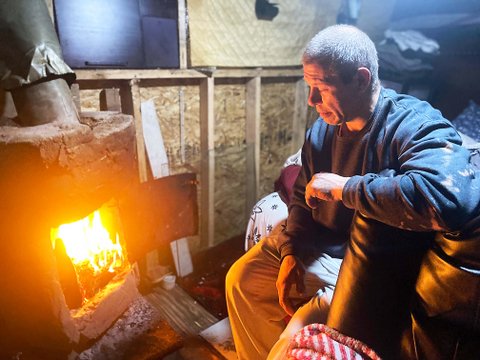
Cecil Martinez, an unhoused Richmond resident when this photo was taken, sits in front of a lit mortar oven to warm himself in January 2022. (Denis Perez-Bravo / CC Pulse file)
By Samantha Kennedy
Living outside is killing people, according to advocates for unhoused residents in Contra Costa County.
While the county does not keep a record of death by cold weather exposure, advocates say near freezing temperatures increase the risk for people living outdoors.
With 816 emergency shelter beds and an estimated 2,118 people in the county who are homeless, finding refuge to get through cold winter nights is not easy. For homeless Antioch residents — the county’s largest unhoused population — that shelter is often nowhere to be found.
There are no warming centers open in East County as winter begins. A city facility intermittently used is currently closed. That means the closest emergency beds and warming centers, which each offer a bed for a single night, are in Concord and Walnut Creek.
“There’s literally people on the street who are freezing to death, or dying due to illness, or having an illness and not being able to take care of themselves when it’s freezing cold outside,” said Nichole Gardner, founder of Facing Homelessness in Antioch, a nonprofit that provides basic necessities for homeless residents.
The total count of those experiencing homelessness and of deaths among that population have declined, according to the county’s most recent data. In 2023, 113 people who were homeless died; that number dropped to 76 in 2024.
But Gardner has been skeptical of the decline in homelessness.
The county’s annual point-in-time count shows large decreases from 2024 to 2025, with Antioch’s homeless population dropping by 40% and the county’s by 25.5%. The report found 246 people were homeless in the city this year, more than the rest of East County combined; only Richmond also had more than 200 unhoused residents.
Officials said the decline was thanks to a 34% increase in temporary and permanent housing since 2023 and additional housing developments. But Christy Saxton, director of the county’s health, housing, and homeless services department, said that, even with a variety of resources, beds are full.
“We are a county that often runs at capacity or near capacity every single night, every day of the year, so we don’t have a lot of open beds,” said Saxton.
Despite Antioch’s homeless population, Saxton said that no facility has been identified by the city or outside providers that could offer a warming center within the city.
“It’s not for a lack of desire to want to open facilities and prop up facilities, [but] there’s a lot of regulations that go along with that. Unfortunately, it’s not as simple as opening doors and letting people in,” said Saxton. “We and the city of Antioch are both bound by state and local regulations.”
The city has previously used the Nick Rodriguez Community Center as a warming and cooling center, but it is currently closed.
City Manager Bessie Scott did not respond to requests for comment on what the city is planning to do about the lack of warming centers, but said at the Dec. 9 City Council meeting that she would look into propping something up before the council can formally vote on anything next year.
It’s unclear what that exact plan would be, but a report from Scott showed that at least one church had shown interest in providing shelter if the city paid, and Gardner said she heard that motel vouchers were mentioned.
In January, only 40% of homeless county residents were sheltered, the point-in-time count found. The rest were living in tents, outdoors, or in cars or other vehicles.
Gardner said the city’s downtown area has a large homeless population, and reports of homeless encampments to the city show they are located across neighborhoods, outside businesses, in fields, and in vacant buildings or lots.
Many of the dozens of reports in the last several months reference several resources and services the city should offer to people in encampments. But some residents say that the idea of an excess in resources for homeless residents is a misconception.
Melissa Case, an Antioch resident who is not homeless, challenged herself to find a bed after hearing about the lack of resources. What she found, she said, was that the process was “kind of a mess.”
Case said she sat on the phone for up to 1 1/2 hours with 211 when attempting to find a shelter bed.
There was a “troubling cycle of miscommunication between 211, CORE, and local shelters, and inconsistent information about transportation availability,” Case wrote in an email to county and city officials that she shared with The Pulse.
Winter conditions can become even more dangerous, Gardner said, when unhoused residents have belongings taken from them during sweeps by the police department or code enforcement.
“When you’re taking their tents and their blankets and everything they need to stay warm, that’s challenging for folks living on the streets who don’t have jackets or anything to keep them out of the elements,” she said.
The city received $6.8 million in state funding from the state Encampment Resolution Fund, which helps jurisdictions clear encampments and offer services to people who are homeless. But it comes with strings attached. Recipients have to remain compliant with all rules and regulations, including homelessness laws, or can risk having funding taken back.
Officials used the grant for services related to the Sunset Drive and Devpar Court encampment, which includes the Opportunity Village transitional housing program and partial funding for a city-dedicated Coordinated Outreach Referral Engagement team.
Several shelter options are located in Richmond, with others in Central County. One, a Winter Nights safe parking program, is in Antioch and also operates a family shelter with varying locations.
“The county is really hurting Antioch by not giving [us the] resources,” said Case, who noted that some of it may fall on past city officials for not applying for grants.
Antioch City Council is expected to address the warming center issue at its Jan. 13 meeting, its first of 2026. That meeting will be held at 7 p.m. at City Hall, 200 H St.
Follow-up:
With No Warming Center, Antioch Looks to Open Local Motel to Homeless People on Cold Nights

No Comments