
06 Jan Honoring the Life of Betty Reid Soskin, Nation’s Oldest Park Ranger and Witness to Port Chicago Exoneration
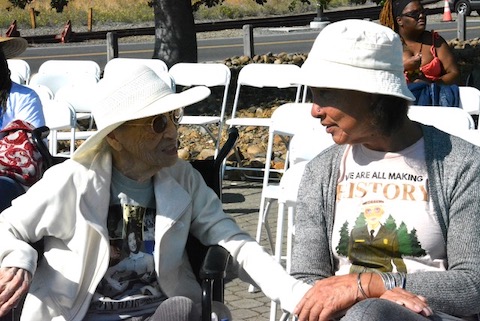
Betty Reid Soskin, left, attended the 80th commemoration of the Port Chicago disaster near Concord on July 20, 2024. Soskin and her husband were hosting a party in Berkeley on July 17, 1944, when an ammunition explosion at the Port Chicago Naval Magazine killed 320 sailors, 202 of whom were African American. About eight Black sailors left the Soskins’ home to return to the naval base. She never saw them again. (CBM photo by Antonio Ray Harvey)
Antonio Ray Harvey | California Black Media
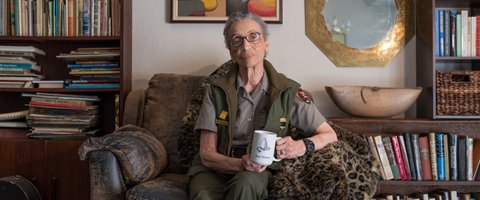
Betty Reid Soskin, the nation’s oldest former active National Park Service ranger and a lifelong witness to and advocate for Black history, died peacefully on Dec. 21, 2025, at her home in Richmond. She was 104.
Surrounded by family and friends, Soskin closed a life that spanned more than a century of American history — one she helped document, challenge and reinterpret for future generations.
“Betty’s legacy will inspire future generations to share stories and recognize the influence individuals can have on how history is understood,” said K. Lynn Berry, superintendent of the Rosie the Riveter/World War II Home Front National Historical Park in Richmond.
Soskin retired in 2022 at age 100, making her the oldest active ranger in United States history. She began her tenure with the National Park Service at age 85 at the Rosie the Riveter/World War II Home Front National Historical Park, a site honoring the estimated 18 million women and workers who supported the U.S. World War II effort.
Born in 1921, Soskin’s life was defined by public service, cultural preservation, and civil rights advocacy. During World War II, she worked as a clerk for the segregated Boilermakers Union A-36 in a Richmond shipyard, where she witnessed firsthand the racial discrimination faced by Black workers. She briefly worked for the U.S. Air Force but quit after discovering she had been hired under the mistaken assumption that she was white.
In 1945, Soskin and her first husband, Mel Reid, founded Reid’s Records in Berkeley, one of the first Black-owned record stores in California. She later married William Soskin and continued her work as a civil rights activist, songwriter, and field representative for members of the California State Assembly.
In 2018, she published her memoir, “Sign My Name to Freedom.” In 2021, a middle school in El Sobrante was renamed in her honor.
Soskin was also a primary witness to one of the most devastating and consequential tragedies in U.S. military history — the Port Chicago disaster.
On July 17, 1944, a massive ammunition explosion at the Port Chicago Naval Magazine killed 320 men, most of whom were Black sailors. Soskin, then 22, was working as a clerk in a segregated union hall in nearby Richmond.
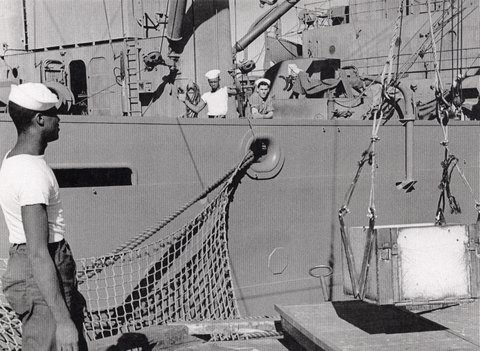
Reflecting the racial policies of the U.S. military at the time, enlisted Black sailors were almost exclusively assigned to the dangerous, labor-intensive task of loading munitions onto ships, while all commissioned officers and Marine guards were white.
That day, Soskin and her husband were hosting a party at their Berkeley home. Black members of the Navy were in attendance but had to return to the Port Chicago base later that evening. She never saw them again.
Two ships were docked at the pier — the Liberty ship SS E. A. Bryan and the Victory ship SS Quinault Victory. The E. A. Bryan was heavily loaded with ammunition, while the Quinault Victory had just begun loading. Hundreds of tons of explosives were also staged on railcars along the pier.
The explosion occurred at approximately 10:19 p.m., shaking the entire San Francisco Bay Area, including Soskin’s home in Berkeley. Reports later indicated the blast was felt as far away as Reno, Nev.
Soskin later learned that one of the sailors at the party was just 16 years old, having altered his birth records to enlist.
“I have never known whether he survived (the explosions). That image of that young man continues to come up to me,” Soskin said in a 2010 Port Chicago documentary produced by Rodney Speed.
In total, about 320 people were killed in the explosion, including 202 Black sailors. Four hundred others were injured.
Following the disaster, 256 Black sailors refused to return to work under the same unsafe conditions. While 206 eventually resumed their duties, the remaining men stood firm. They were convicted of mutiny and became known as the Port Chicago 50.
On June 20, 2024, at the Port Chicago Naval Magazine National Memorial in Concord — now part of the Military Ocean Terminal Concord operated by the U.S. Army — Soskin, then 102, witnessed a moment eight decades in the making.
Former U.S. Secretary of the Navy Carlos Del Toro spoke at the 80th Anniversary Commemoration of the Port Chicago disaster, announcing the full exoneration of 256 Black sailors convicted of mutiny and related charges.
Soskin sat quietly during the ceremony, listening as Del Toro called the exoneration a “landmark moment” that “clears their names, restores their honor and acknowledges the courage they displayed in the face of immense danger.”
“This event marks a turning point in our nation’s history, a moment when we confront the ghosts of the past and embrace the promise of more justice,” Del Toro said. “For eight decades, the story of Port Chicago has been a stark reminder of a grave injustice. We as a nation will never be able to express our full gratitude to all deceased and their families for their dedication, service, and sacrifice.”
Among her many contributions to Black California — particularly in the East Bay — Soskin lived to see justice acknowledged for the sailors whose lives were shattered by the Port Chicago explosion.
“Betty Reid Soskin was among the best of rangers — those who create links between history and future generations,” Berry said. “Her voice enriched and expanded the Rosie story, presenting a broader view of the American home front.”
Former President Barack Obama, whose inauguration Soskin attended, also recognized Soskin’s impact on American history and public service, citing her as a powerful example of civic engagement and historical truth-telling. Obama praised Soskin for her commitment to ensuring that the stories of Black Americans, particularly during World War II, were fully acknowledged and preserved, noting that her work helped broaden the nation’s understanding of its past and the people who shaped it.


No Comments