

06 Jan Lessons From Kenya: I Found Beauty, Inequality and Unexpected Joy
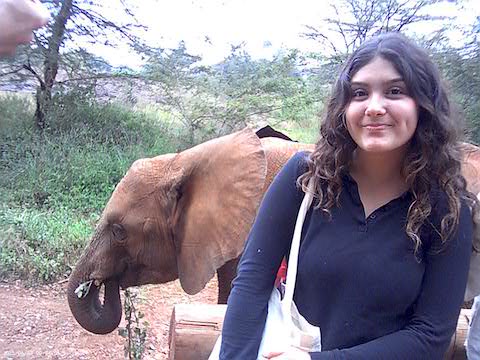
The author spent two weeks in Kenya on a school trip. “Kenya was not one experience,” she writes. “It was many. (Courtesy of Yaslin Rodriguez)
Commentary, Yaslin Rodriguez
Last summer, I traveled to Kenya with seven students and two adults from my school. Our goal was to learn and to experience. And that is exactly what we did.
As American students, everything about us stood in contrast to our surroundings. I met people from all walks of life, from private school classmates to children living in Africa’s largest so-called slum. I saw beauty, joy, inequality and hope woven into a country far more complex than I had imagined.
Nyeri
Nyeri Town was loud and alive, with traffic and people walking all around. But what stood out to me the most was the way people looked at us. Not hostile but direct, sometimes with a smile. People were curious.
In white polos and khaki pants, clearly foreign, we stood out. I tried to just smile and keep walking, but I felt uncomfortable. I became aware of every step I took and every word I spoke. I wondered what people thought of us. But the longer I walked, the more I realized that immersion isn’t about staying invisible. It’s about stepping into someone else’s world, fully and honestly.
That walk through Nyeri shook me out of my comfort zone. Being uncomfortable meant learning something real.
Mt. Kenya Academy
For most of the trip, we stayed at Mt. Kenya Academy.
The students welcomed us with curiosity, kindness and eagerness to connect, the girls singing, “Jambo, jambo bwana! Habari gani? Nzuri sana,” which is a Swahili welcoming song.
We played basketball, talked about our lives and compared classes, music and fast food. Quickly, we went from being “the visitors” to feeling like part of the group. Though we came from different backgrounds, we laughed at the same things and stayed up late talking about our lives at home. I showed them photos from my family, and we talked like we’d known each other for years. It showed me that human connection can break through any barrier — if you let it.
Chania
We also visited Chania, a nearby public school. A leader introduced us by name, grade and favorite ice cream flavor. The students cheered for cookies and cream and mango.
After our introduction, we were brought over to the food table and given cups and buckets of hot beans, corn and potatoes. It was interesting to see the difference in food between Mt. Kenya Academy and Chania, which was literally a block or two away. At Mt. Kenya, we were served huge plates of rice and curries. Even when you asked for less because you weren’t super hungry, they’d give you a bunch.
Once all the kids were served, I went to sit with them and asked them questions, but the little ones didn’t really understand me. I thought they were being shy. Then I realized there was a huge language barrier. Even so, they had an undeniable energy, with warmth and enthusiasm.
Later, the kids came to us slowly, at first. Then, I started giving out hugs. And they started grabbing my hands, fighting over who could hold them. I would ask them for my hand back and they’d say, “no!” They were pushing my sleeves up to see my arms and grabbing and pulling on my hair. They were grabbing my hair clip and my sunglasses. It was extremely overwhelming — some space would have been nice — but I knew it was pure curiosity and excitement. It was adorable.
It was, however, hard to not feel a sense of guilt. The experiences at the two schools were vastly different. The students at Chania were as bright, curious and full of potential as anyone I’d ever met. They simply didn’t have access to the same tools.
That visit taught me to look beyond appearances. It reminded me of my privileges, the things that I take for granted, and, most important, that being uncomfortable isn’t always a bad thing.
Sweetwaters
Sweetwaters, a luxury conservancy and lodge that caters mostly to international tourists, was such a treat, a complete opposite from the rest of the trip. Everything there felt curated. It was beautiful but also felt distant and protected, a version of Kenya designed to be consumed without discomfort.
Many visitors will only ever see this Kenya. They probably leave thinking they know the country, without ever walking through Nyeri or hearing the laughter of the students in Chania. Sweetwaters showed me how easy it is to build a version of a place that’s safe and controlled. But that version, while beautiful, only tells a small piece of the truth.
Father Marcel
Later in the trip, we heard a lecture from a religious leader, Father Marcel. We told him what we want/like to study. One of the adults leading our group asked about the most important issues in Kenya. Father Marcel talked about seeing the glass as half-full instead of half-empty: There would always be good and bad news, but it is important to see the vibrancy in Kenya and the people living in joy.
One of my groupmates asked how his past influences who he is today. He told us his parents and siblings had been killed in the Rwandan genocide. Later, he met their killer face to face. He feared for his life. He was unsure whether he was going to live or “end up on the same path as his family.”
He told us that it’s best not to dwell on the past but to think about today. The man who killed his family asked him for forgiveness, and though it was hard, Father Marcel said he told the man that he forgave him. He told us, “To forgive is not to forget, but it is to change how you view the past.” That really stuck with me.
I was struck by how someone who had endured so much could still speak with such gentleness and hope. He wasn’t bitter but wise. His story stayed with me long after, a reminder that true strength often looks nothing like power and everything like peace.
Kibera
On our last full day, we visited Kibera, Africa’s largest urban “slum.” We were all a little scared before we went. I had my assumptions about what it would be like, and I expected to feel drained afterward.
But the visit completely shattered every stereotype I had, even the ones I didn’t know I held. Yes, there was poverty, though I wasn’t worried about that, and the streets were bumpy. But there was also color, music, laughter and life.
The town was vibrant. I had worried we might encounter some hostility because we all look like and are privileged private school kids. Instead, people looked at us with curiosity and smiles. I felt so welcome. We followed a guide as we walked on rocks, over dirty water puddles, trash and clothes. It wasn’t the cleanest, but we got so many smiles and welcoming hellos or jambos, a Swahili greeting. We eventually reached the Foundation of Hope, a creative center filled with music, art, dance and joy. The energy was contagious. We joined in dances, laughed through moves that we weren’t used to, and watched as young artists performed with passion and pride.
Four young women, about our ages, walked in the room and started to dance. This dance was not like any other I had seen live before. It was free and welcoming and alive. They moved everywhere, moving every part of their bodies. It was loud, but I was so intrigued, and I felt so alive. There was no trace of self-pity, just expression, strength, and a deep love for community.
Kibera taught me that resilience isn’t always quiet. Sometimes, it’s loud and vibrant and full of rhythm. It was neat to see how such a financially poor place was so emotionally rich and happy. It was like nothing I’ve seen in America.
Final Reflection
Thinking back to those first days in Nyeri, walking through unfamiliar streets under curious stares, it’s hard to believe how much changed in two weeks. I came to Kenya expecting to learn about another culture; I ended up learning about myself, about inequality, and about the power of connection.
Kenya was not one experience. It was many. It was the laughter of new friends, the sharp contrast between privilege and poverty, and the unexpected beauty of places I thought would only show pain. It reminded me that the world is complicated, layered, and deeply human. If you want to understand it, you can’t just look from a distance. You have to step into it, feel it, and let it change you.
So many different people experience different parts of Kenya.
To put it into perspective, think of San Francisco. It is known for homelessness and luxury. Both realities exist, but the city is also more than either of those things.
Similarly, Africa isn’t just starvation or safaris, though those things definitely do exist.
This trip taught me that truth doesn’t live in stereotypes. It lives in the in-between — where real people live full, complex lives.

No Comments