


16 Jan Organizers of Training on Missing and Murdered Indigenous People Urge Law Enforcement to Notice the Crisis
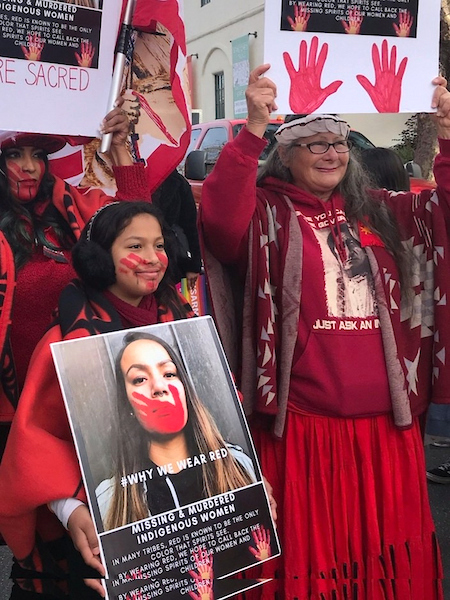
Sand City Mayor and Supporting Indigenous Communities Group Chair Mary Ann Carbone, right, takes part in a remembrance for missing and murdered Indigenous people in California and North America. The SICG held a training on the crisis in Monterey in November 2025. (SICG via Bay City News)
By Thomas Hughes
Bay City News
Law enforcement agencies across California are marking January as National Human Trafficking Prevention Month, and organizers of a recent Native and Indigenous-led training conference in Monterey are urging police departments, sheriff’s offices, and prosecutors to take advantage of opportunities to build trust with Native and Indigenous communities when they are offered.
There are resources available for law enforcement to help end a widely acknowledged — yet hardly recognized — crisis of missing and murdered Indigenous people in California. But police have to know about and take advantage of them to influence change.
Recognition of the crisis of missing and murdered Indigenous people, referred to as MMIP among advocates, has been halting and slow since it was thrust into the public spotlight by a Canadian artist in 2010. The U.S. Department of Justice recognized the crisis in 2019 by devoting extra resources to gathering information on the high numbers of missing, murdered or trafficked Native and Indigenous people, who are mostly young women.
California began passing legislation in 2020 to address the disproportionate number of Native and Indigenous people who are victims of human trafficking, missing persons or involved in homicides that go unsolved or unreported.
California has the fifth-highest number of violent crimes committed against Native or Indigenous people in the nation. Native Americans and Native Alaskans make up less than 2% of the population but are identified as victims in 40% of sex trafficking cases in the United States, according to the FBI’s National Crime Information Center.
About 84% of Native women in the U.S. experience violence in their lifetime, as do about 82% of Native men, far higher than the general population, according to the National Congress of American Indians. In some jurisdictions in the U.S., Native women are murdered at more than 10 times the rate of any other group, and crimes against Native and Indigenous people are seven times less likely to be solved, according to a 2016 study from the National Institute of Justice.
There are hundreds of unrecognized tribes in the state, complicating visibility and data collection issues even further.
Tools like the Feather Alert public notification system; databases like the National Crime Information Center and National Missing and Unidentified Persons System; and regional resources from the California Highway Patrol, state Attorney General’s Office and U.S. Department of Justice can all help provide law enforcement with information about how to better serve crime victims and help end a manmade epidemic of violence against Indigenous people that was once encouraged by the state through bounties offered by the government and forced placement in boarding schools.
Consulting trauma-informed advocates who can help develop ways to support crime victims in culturally appropriate ways is also critical to healing the crisis, which is in part amplified by a historic mistrust of law enforcement by Native and Indigenous communities.
A lack of clear jurisdictional authority for tribal police departments and courts also slows and complicates investigations and prosecutions, according to those who work on legal solutions to the crisis in the Attorney General’s Office, tribal governments and nonprofit advocates.
The first law enforcement training conference that was certified by the California Commission on Peace Officer Standards and Training, known as POST, was held in Monterey in November, but organizers said in interviews this month that they were disappointed by the low turnout and apparent lack of interest from law enforcement agencies that were invited.
Members of the nonprofit organization Supporting Indigenous Communities Group, who hosted the conference, are urging law enforcement to utilize tools like the Feather Alert — which lets the CHP know a missing person is Native or Indigenous — and other investigative methods to better coordinate with state, regional and tribal law enforcement to conduct more seamless investigations.
The Feather Alert system was just one tool covered in the training conference, which was held at the Portola Hotel and Spa after a local university backed out, and after two years of planning, according to organizers. Funding was provided by the Federated Indians of Graton Rancheria and other sponsors.
The training conference was developed in part by Sand City Mayor Mary Ann Carbone (Chumash), who was driven to organize it after speaking to a member of law enforcement who was unaware of the Feather Alert system, and by Supporting Indigenous Communities Group vice chair Ismana Carney.
The two invited law enforcement representatives from the state and local level, along with trainers who could provide culturally sensitive, trauma-informed support techniques for law enforcement to let crime victims know they are supported and their cases are important.
After the low response from law enforcement agencies, Carney and Carbone said they expanded the idea of focusing on law enforcement training to a more encompassing theme of providing resources for impacted individuals and communities, including healing, mediation and wellness resources.
The Supporting Indigenous Communities Group reached out to student groups, faith leaders, law schools, nonprofits and health care providers, and invited several local Native and Indigenous tribes and community members to participate, including Pajaro Valley Ohlone Indian Council, Esselen Tribe of Monterey County, Mutsun-Ohlone Band, Indian Canyon, Muchia Te Indigenous land Trust, and about two dozen other tribes from around California and the U.S.
The Supporting Indigenous Communities Group previously held red dress day events to highlight the crisis, using a symbol that was popularized by Native Canadian artist Jaime Black in 2010 to raise awareness of the issue in Canada. But the group had never held a training conference to inform law enforcement of how it could better serve the Indigenous community, whether they are living on a reservation and under the jurisdiction of tribal police departments, or living in urban or rural environments and not enrolled in a federally recognized tribe.
The effort to have the curriculum certified by POST was influenced by Sand City Police Chief David Honda, who told organizers it would help attract more law enforcement participation. Honda, Seaside Police Chief Nick Borges, and Monterey County Sheriff Tina Nieto attended, and all gave high marks to the conference, its goals, and what it brought to law enforcement.
Carney also made clear that the initial goal of the conference was to center the stories and impacts of violence in the Indigenous community and inform law enforcement how those impacts were being experienced. The conference also sought to connect Native communities with resources to help them, but the goal wasn’t to create a POST-certified course on behalf of law enforcement.
Organizers considered the POST certification process laborious and said they were left waiting to receive a response from the commission right up to the date of the conference on whether the training had met its specifications. Ultimately, despite what they perceived as low turnout among law enforcement, the POST certification did receive considerable attention when it came to highlighting what made this conference different from other training and informational sessions on the crisis of violence.
Representatives from the Attorney General’s Office, CHP and Monterey County District Attorney’s Office attended the conference and some gave training sessions on different topics such as data collection improvement, local cases, and the intersection between the missing and murdered Indigenous people crisis and crimes like human trafficking, domestic violence, stalking and sexual assault.
Maija West, a former attorney who worked with victims of human trafficking and who led a training session on the topic, said in an interview that society was just starting to grapple with the subject in a full way.
“Understanding human trafficking is in its infancy,” she said.
West said the public, businesses and victims alike can be unaware of the signs someone is being trafficked, including in cases of forced prostitution. But she also alleged that the justice system in Monterey County was slow to respond to a client’s case and wondered who such negligence benefits in a county with a long history of labor exploitation in its farm and canning industries.
West told the story of a client she represented on the Central Coast who was trafficked from Oaxaca and exploited for sex work as a minor. She said that her client was able to get out of the situation with legal help, but said many others don’t have such help.
Ultimately, West was not unable to get the case categorized as an instance of trafficking because of what she said was an “unseen power structure” that protects perpetrators.
“Trafficking of Indigenous people is a past and present problem,” West said. She went on to say, “most trafficking takes place where men are not held accountable.”
She said the only way to put an end to the crisis was to understand what different types of trafficking exist and if communities, including Monterey County, were willing to examine an “ugly side” of themselves.
Attorney General Rob Bonta and Monterey County District Attorney Jeannine Pacioni spoke at a press conference that preceded the training day. Both said that deliberate steps had been taken at the state and local level to better address and reduce the crisis but acknowledged that there was much more to be done, including improving data collection and potentially making the POST training mandatory.
Borges, Seaside’s police chief, said he was unaware of the Feather Alert system before the training conference and was unaware of the magnitude of the crisis impacting Native and Indigenous communities, calling the training “eye opening.”
There are no federal or state acknowledged sovereign tribal lands in Monterey County, tracing back to historic displacement by Spanish and American colonization. The Esselen Tribe of Monterey County acquired land in Big Sur in 2025 in a historic reestablishment of a home for the local tribe, but it does not have sovereign recognition and therefore does not have its own police department.
But a person does not have to be enrolled in a recognized tribe to be eligible for the Feather Alert system. Anyone who claims Indigenous or Native heritage can have the alert triggered from local law enforcement, if requested by a reporting party, and police departments should not deny such requests, according to the legislation that established the alert.
That can be especially relevant on the Central Coast, where migrants from Oaxaca, often Indigenous, are the victims of trafficking for labor and sexual abuse. Language barriers can be more prominent for migrants that do not speak Spanish or English as a primary language.
With the Super Bowl approaching in February in Santa Clara, law enforcement is ramping up efforts to detect and eliminate human trafficking, with several agencies, including the Santa Clara County Sheriff’s Office, saying there is a notable surge in such crime when large events like that are held.
Borges said in an interview after the conference that it was “a big deal” that the training had received POST certification and said he would recommend his officers go through it. He predicted more law enforcement would take advantage if the training were to be held again.
“It’s disgusting this is happening and overlooked in our society,” he said.
He said law enforcement and the justice system was “far behind” what it needed to be to address the volume and complexity of crimes associated with what is sometimes referred to in shorthand as the MMIP crisis.
“It’s civil rights, in my mind,” he said. “It comes down to basic common humanity.”
The Feather Alert is a public notification system that went into effect in 2023 and was created by Assembly Bill 1314 by Assemblyman James Ramos (Cahuilla, Serrano), D-San Bernardino, who has been at the forefront of several initiatives to get more public resources to end the manmade epidemic of violence against Native and Indigenous people.
Efforts were made in recent years at the state and federal level to better address the crisis, including two pieces of federal legislation that created task forces and reduced jurisdictional confusion. Those laws were Savanna’s Act and the Not Invisible Act.
At the state level, a pilot program started in 2025 is giving three tribal police departments in California peace officer status to give them the authority to enforce state law, with the goal of reducing some of the jurisdictional challenges that make responses to domestic violence and missing persons investigations slower and less coordinated.
The CHP recently created regional tribal liaisons throughout the state, and the Attorney General’s Office created a new position in 2025 called the Senior Assistant Attorney General for Native American and Tribal Affairs to advise the attorney general, governor and state agencies on tribal justice issues.
The effort to continue the Native-led MMIP training with law enforcement and impacted communities will likely continue in fall 2026 as organizers in the Bay Area look to replicate and adapt the Monterey conference.
Planning is in the beginning stages, according to Catalina Gomes (Salinan, Rammaytush, Bay Miwok), a conference attendee and the executive director of the Muchia Te’ Indigenous Land Trust, which seeks to repatriate lost lands.
Gomes said she was inspired to host an event specific to the Bay Area after what she considered a successful event in Monterey, despite what she also said was a lack of participation by law enforcement in higher numbers.
Copyright © 2026 Bay City News, Inc. All rights reserved. Republication, rebroadcast or redistribution without the express written consent of Bay City News, Inc. is prohibited. Bay City News is a 24/7 news service covering the greater Bay Area.



No Comments