

20 Jan ‘More Forceful Medicine Is Needed’: As Health Care Subsidies Shut Down, Advocates Push for Aggressive Policy
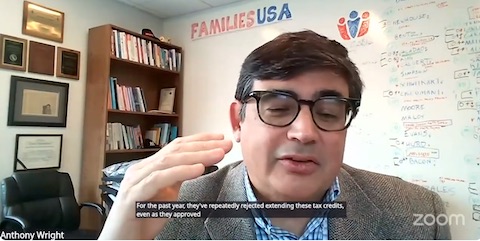
When fewer people are covered by health insurance, Anthony Wright of Families USA says it “has a cascading impact on increased costs and on decreased services for everybody, not just those who are directly impacted.” (Screenshot captured by Aina de Lapparent Alvarez / The CC Pulse)
By Aina de Lapparent Alvarez
For the past two and a half months, millions of Americans have agonized over whether to forgo or downgrade their health insurance as premiums surged nationwide. This year, health plan costs increased by an average of 114%, according to the Kaiser Family Foundation.
The increase follows Congress’ decision not to extend a President Biden-era tax credit which lowered costs on the Affordable Care Act Marketplace. On Friday, American Community Media hosted a panel to explain how the subsidy’s lapse will affect access to health care and what is being done to face that crisis.
Open enrollment for health insurance closed Thursday in 43 states. So far, 1.4 million fewer people chose coverage on the ACA. Anthony Wright, executive director of the nonprofit Families USA, thinks that preliminary numbers are just the tip of the tragedy.
By the end of the month, the six remaining states, including California, will close their sign-up window, he said. “Many more folks fall off coverage as they are not able to pay that higher premium in January, in February, in March, especially after certain grace periods and other things come into effect.”
What can people do at the individual level?
Wright outlined several steps consumers can take in states where enrollment remains open.
First, use official websites like healthcare.gov or Covered California to avoid websites with “junk plans” that don’t meet regulations.
Second, he encouraged consumers to shop and compare. “The best deal last year would not necessarily be the best deal this year,” Wright said, “especially with this dramatic change in the expiration of some of the subsidies that are available.”
The expired subsidy was for people making between 400% and 600% of the poverty level ($62,000 to $94,000 for an individual or $128,000 to $193,000 for a family of four). But the baseline tax credit is still available for people under 400% the poverty level which is $60,000 for an individual and $125,000 for a family of four.
A third and “not great option” is buying down. Underinsurance can still be a safety net against full bankruptcy, however, in case of an accident or health scare. In California, a bronze plan includes three doctor visits for preventive care, Wright said.
Some states have stepped in, with New Mexico approving additional subsidies and California looking into similar options. But answers won’t come from the individual or the state level, Wright said.
“What the states can do is a fraction of what was in the federal deal,” he said. “So we need federal action.”
Wright pointed to a House vote earlier this month supporting a three-year extension, which included backing from 17 Republicans. Open enrollment might be over, but the fight is ongoing.
Why is health care so expensive in the U.S.?
The widening gap in health care access goes beyond the problem of subsidies. According to Neale Mahoney, a professor of economics at Stanford University, the United States spends the most of any country on health care.
Over the last two generations, health care expenditure has increased from 8% to 18% of the country’s gross domestic product. While about a third of the federal budget goes to health care, and employers contribute for 160 million Americans, prices are too burdensome. For a family of four, $27,000 is the average cost of health care this year, according to the Kaiser Family Foundation.
“If you are a small business owner or you are a firm trying to make it in a difficult environment, providing that health insurance, even if you think that’s hugely important to your employees, is a huge weight on your bottom line,” Mahoney said. “The body of evidence we have suggests that higher health care costs mean lower wages and less jobs.”
And it’s about to get worse for all, Wright said.
People opting out of insurance tend to be healthier, so the pool will be smaller and sicker. Premiums will rise. “This has a cascading impact on increased costs and on decreased services for everybody, not just those who are directly impacted,” he continued.
‘Push on all the available levers’
Addressing the health care crisis will require multiple approaches, panelists said.
“There isn’t one quick fix to reform our health care system,” Mahoney said. “To make meaningful progress, we actually have to push on all the available levers.”
One challenge is ensuring there are enough health care workers, particularly in rural and other underserved communities. Mahoney said loosening caps on how many doctors can train, allowing more doctors to immigrate from other countries, and expanding the scope of care nurses and other practitioners can provide would be helpful.
Another fight is controlling costs. Mahoney pointed out that Medicaid work requirements add administrative burdens, which make it more costly. Also, expanding Medicare to younger folks and negotiating more drug costs would make health care markets more competitive.
“I think even economists who tend to be skeptical about price controls and about the public sector realize that more forceful medicine is needed in the healthcare sector,” Mahoney said.
Merith Basey, executive director of Patients for Affordable Drugs, a nonprofit focused on policies to lower drug costs, said prescription drug prices in the U.S. are four to eight times higher than in other high-income countries.
To counter that, policy needs to support generic medicine, which lowers the price of the already existing drug by 39% and competition, which cuts prices by 95%, Basey said.
There is a glimmer of hope in drug price negotiations, Basey added, thanks to the work of Families USA, Patients for Affordable Drugs, and other organizers.
Since Jan. 1, the cost of the costliest and most commonly used drugs like insulin and cancer drugs, went down by 63%.
Basey said expanding negotiations to include the 60 most expensive drugs would be a critical step toward reining in prescription costs.

No Comments