
23 Jan Advocates Take to the Streets to Gain Support for Public Transit Funding
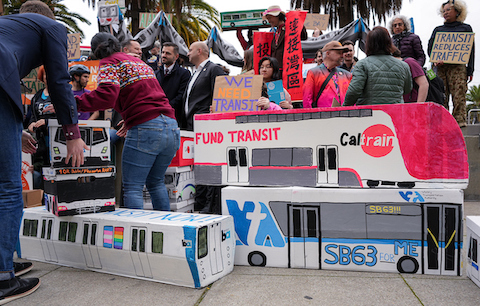
Organizers set up bus and train decorations in Embarcadero Plaza in San Francisco at a rally in support of public transit on Friday. Public transit advocates are collecting signatures to require a November sales tax ballot measure for public transit to only need a simply majority approval from voters.
Story and photos by Andres Jimenez Larios
Bay City News
A large coalition of politicians, community leaders, and public transit advocates gathered in San Francisco’s Embarcadero Plaza on Friday morning in support of a petition-signing drive for a ballot measure that could provide long-term funding for transportation operators at risk of drastic cuts to their services.
The state Legislature last year authorized putting a sales tax on the November 2026 ballot via Senate Bill 63, also known as the Connect Bay Area Act, but local leaders at Friday’s rally urged citizens to sign a petition that would make it easier to pass the tax.
In California, a voter-approved regional measure for a new sales tax would normally require a two-thirds majority approval if the Legislature directly places it on a ballot. Transit advocates, however, have begun collecting signatures to make the sales tax a citizen-initiated ballot measure that would lower the threshold to a simple majority of votes cast and avoid the need for supermajority approval.
Politicians like state Sen. Scott Wiener, D-San Francisco, stressed the need for long-term funding sources for the region’s operators.
“These systems are going to unravel,” said Wiener at the morning rally. “The Bay Area will look extremely different. Congestion is going to be through the roof. So many people are not going to be able to get to work or school or to see their family. This will be a nightmare for the Bay Area, and we cannot, and we will not let that happen.”
-

- “Without new and sustainable funding, the Bay Area will face a true transit emergency, and so just know that this is all hands-on deck,” said Oakland Mayor Barbara Lee, at lectern. “So many working people in terms of Black and Brown people, low-income people, our seniors, people who need public transportation will lose public transportation.” The men in suits standing immediately behind Lee are, from left, state Sen. Jesse Arreguin, San Francisco Mayor Daniel Lurie and state Sen. Scott Wiener.
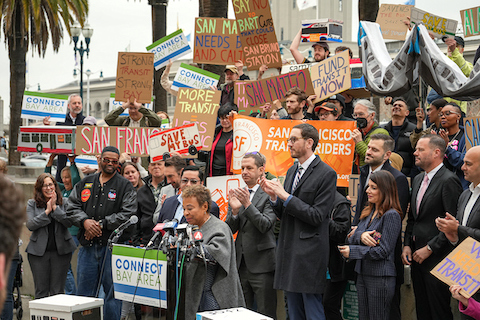
Oakland Mayor Barbara Lee joined her colleagues in calling for robust funding sources for public transit. She said it was imperative to keep the region running and is an important method for socioeconomically disadvantaged communities to get around.
“Without new and sustainable funding, the Bay Area will face a true transit emergency, and so just know that this is all hands-on deck,” said Lee. “So many working people in terms of Black and Brown people, low-income people, our seniors, people who need public transportation will lose public transportation.”
If approved by local voters, it would establish a 14-year sales tax on retail transactions that would be used to fund transit operators in the counties of Alameda, Contra Costa, San Francisco, San Mateo, and Santa Clara.
State and federal emergency funds were made available for public transit operators after COVID-19 caused a drastic decline in ridership. Agencies traditionally relied on passenger fares for operating income, but that model is struggling to keep up and those emergency funds that helped cover costs are set to expire by the end of June this year.
In a report last year, the regional transportation planning agency Metropolitan Transportation Commission found the five largest public transit operators will have an average collective annual deficit of $914.8 million starting in fiscal year 2027 and every year onward.
The coalition of speakers and supporters included individuals representing the business community. John Grubb is the interim president of the Bay Area Council, an organization that advocates for the development of business in the region, and he said that economic ruin awaits the Bay Area if transportation fails.
“When transit weakens, traffic explodes, deliveries slow, and the cost of business goes up for everyone,” said Grubb. “Our roads are already full. You don’t have to ride transit to depend on it. Every full train is hundreds of cars not on the road.”
Wiener said people who may be opposed to a new sales tax should try to imagine the big picture and what is at stake.
“Which is more harmful, having to pay a little bit more in sales tax or literally not having a train or a bus to take?” said Wiener. “People need to envision what the Bay Area will look like if BART collapses, if Muni eliminates half of its service, if AC Transit cuts service, if Caltrain collapses, what does that mean for the Bay Area? People are literally not going to be able to get around and even if you’re a driver, the traffic is going to be horrific.”
Among those helping to acquire signatures for the petition were University of California, Berkeley students Syrak Micael and Florance Zhang. They said they were mobilized to support public transit because they have come to rely on it every day.
“As young people, as students, our main means of transportation are walking, biking and buses,” said Micael.
“I myself depend on transit and I know a lot of people in Berkeley and everywhere in the Bay that depend on transit,” said Zhang. “I think it’s important for young people and students to come out and talk about how important it is and support the measure.”
-
- “I can’t drive, so transit is literally the way I get around and able to do anything outside of my door, outside of my home, and the way I get to work,” says Alameda resident and electric wheelchair user Sophia DeWitt.
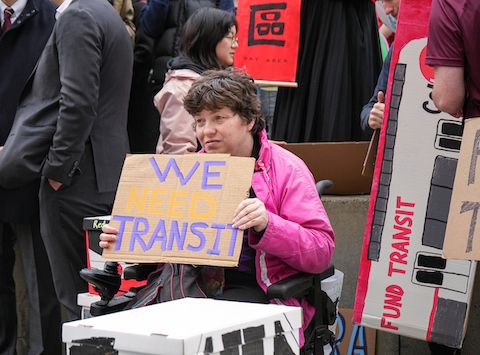
Alameda resident and electric wheelchair user Sophia DeWitt said she relies on public transit to keep her independent.
“At a personal level, I’m a transit-dependent rider,” said DeWitt. “I don’t have a car, I can’t drive, so transit is literally the way I get around and able to do anything outside of my door, outside of my home, and the way I get to work. It’s the way I get to the doctor or the grocery store, just any of those things. And it improves the quality of my life.”
Organizers said they raised $3 million for the signature campaign that will be used to support the qualification and passage of the measure.
Over the next few months, advocates are looking to receive over 186,000 signatures across the five counties by June 6 to qualify the measure for the November ballot.
Copyright © 2026 Bay City News, Inc. All rights reserved. Republication, rebroadcast or redistribution without the express written consent of Bay City News, Inc. is prohibited. Bay City News is a 24/7 news service covering the greater Bay Area.

No Comments