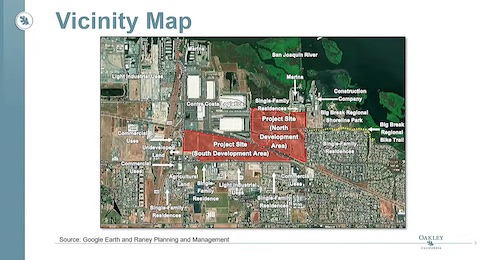
Map of the Bridgehead Industrial Project area in Oakley. (Screenshot captured by Samantha Kennedy / The CC Pulse)
By Samantha Kennedy
An artificial intelligence data center is listed as a possible feature of the Bridgehead Industrial Project in Oakley, but residents made their opposition clear to the city Planning Commission, citing environmental, health and cost concerns.
Residents rallied at Tuesday’s meeting to oppose the project that would bring 3.1 million square feet of logistics buildings, an industrial warehouse, and a possible data center to two split areas adjacent to Highway 160 northwest of the city.
Planning commissioners ultimately recommended the project’s approval to the City Council but placed an additional requirement of a Conditional Use Permit for data centers. That means, if a data center were to be part of the project, it would have to get additional approval and review.
“That really closes the gap, if there were any gap between a business just coming in and operating,” said Ken Strelo, Oakley’s community development director. Strelo clarified that no data center was currently being proposed, but said “that doesn’t mean someday they might not, right?”
The vote by commissioners is the first approval of applications for rezoning the sites, adopting design guidelines, dividing the 164-acre project into 10 lots, and certifying the Environmental Impact Report.
Audience members responded to the vote with booing, applauding for Vice Chair Kerry Harvey’s and Commissioner Yared Oliveros’s no votes, and a resident’s outburst about commissioners prioritizing jobs over the environment. That criticism spilled over after the vote.
“Shame on you for not listening to your constituents, you’re not the one who’s going to have the health effects,” one resident told commissioners after the vote.
Surrounding the project areas are residences, the Big Break Regional Shoreline Park and trail, the Oakley Logistics Center, and the San Joaquin River.
Data centers use that energy to power operations and water to prevent overheating in computers that are performing for A.I.
Conan Moats, a member of the Diablo Water District’s Board of Directors, said that about 16.7% of the project could be made up of a data center. Right now, Moats said DWD can provide 71,287 gallons of water per day, around the same amount as the under 100,000 gallons per day Strelo said the project will likely use. Still, Moats questioned how that need might grow should a data center be brought in.
A resident living by the proposed site areas, who only identified herself as Colleen, questioned the strain a potential data center could put on resources.
“Who’s really going to pay?” she asked. “What assurances do we have that we won’t have the droning sounds or vibrations emitting from the data centers 24/7 and affecting people’s health? I don’t want to live with that. Would you?”
A staff report said the project could create 3,500 new jobs and another 3,700 one-time construction jobs while bringing in a $1.1 million surplus to the city.
Those economic benefits were cited by the project’s only public supporters, members of local unions, as a reason to move the proposal forward.
Related Posts:
ChatGPT Is Designed to Make Us Think We’re Right.… "The more I started to rely on [ChatGPT], the more I began to notice something unsettling: how uncritically it supported me," a teen writes on the danger of AI.
AI in the Classroom: Helpful Study Tool or Shortcut… As more students use artificial intelligence tools, teachers are growing increasingly concerned about whether they threaten students' critical thinking skills.
We use cookies on our website to give you the most relevant experience by remembering your preferences and repeat visits. By clicking “Accept”, you consent to the use of ALL the cookies.
This website uses cookies to improve your experience while you navigate through the website. Out of these, the cookies that are categorized as necessary are stored on your browser as they are essential for the working of basic functionalities of the website. We also use third-party cookies that help us analyze and understand how you use this website. These cookies will be stored in your browser only with your consent. You also have the option to opt-out of these cookies. But opting out of some of these cookies may affect your browsing experience.
Necessary cookies are absolutely essential for the website to function properly. These cookies ensure basic functionalities and security features of the website, anonymously.
Cookie
Duration
Description
cookielawinfo-checbox-analytics
11 months
This cookie is set by GDPR Cookie Consent plugin. The cookie is used to store the user consent for the cookies in the category "Analytics".
cookielawinfo-checbox-functional
11 months
The cookie is set by GDPR cookie consent to record the user consent for the cookies in the category "Functional".
cookielawinfo-checbox-others
11 months
This cookie is set by GDPR Cookie Consent plugin. The cookie is used to store the user consent for the cookies in the category "Other.
cookielawinfo-checkbox-necessary
11 months
This cookie is set by GDPR Cookie Consent plugin. The cookies is used to store the user consent for the cookies in the category "Necessary".
cookielawinfo-checkbox-performance
11 months
This cookie is set by GDPR Cookie Consent plugin. The cookie is used to store the user consent for the cookies in the category "Performance".
viewed_cookie_policy
11 months
The cookie is set by the GDPR Cookie Consent plugin and is used to store whether or not user has consented to the use of cookies. It does not store any personal data.
Functional cookies help to perform certain functionalities like sharing the content of the website on social media platforms, collect feedbacks, and other third-party features.
Performance cookies are used to understand and analyze the key performance indexes of the website which helps in delivering a better user experience for the visitors.
Analytical cookies are used to understand how visitors interact with the website. These cookies help provide information on metrics the number of visitors, bounce rate, traffic source, etc.
Advertisement cookies are used to provide visitors with relevant ads and marketing campaigns. These cookies track visitors across websites and collect information to provide customized ads.







No Comments