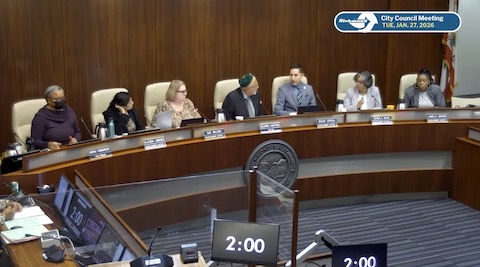
(Screenshot captured by Samantha Kennedy / The CC Pulse)
By Samantha Kennedy
Richmond residents will get a chance to have a say in how the city will use the $550 million Chevron settlement, but who will be leading that process and the diversity of voices heard were points of contention for City Council members at Tuesday’s meeting.
Council members voted 5-1 to hire a consultant who will gather input on how the funds should be invested. Council members Soheila Bana abstained and Jamelia Brown voted no. The consultant could cost up to $300,000, but is estimated to cost $150,000, according to an agenda report from Mayor Eduardo Martinez, Vice Mayor Doria Robinson and council member Claudia Jimenez.
It was one of two proposals that officials had to decide between on how to conduct the engagement with residents. The other, authored by council member Cesar Zepeda, would have put city staff in charge of the process. City staff, however, said it would have been more overwhelmed than it already is.
“What we’re advocating for through this item is to bring in that non-biased facilitator to help facilitate a conversation with community members in every district and go through this landscape of opportunities,” said Robinson.
The city came to an agreement with Chevron in 2024, after a proposed tax measure pushed by environmental advocates was taken off the ballot that same year. Under that measure, up to $90 million annually would have been generated for the city from a tax on the company.
Last year, one proposed use of the $550 million settlement funds was to use the money to pay off its pension debt.
Martinez, Robinson and Jimenez say that central to the principles of the settlement is a “just transition” away from the city’s dependence on fossil fuels and Chevron, according to their report.
Emma Ishii, local policy coordinator with the Asian Pacific Environmental Network, told council members that the item is a “thoughtful framework” that outlines spending matching community needs.
“I know that the community has a clear vision of Richmond’s future, with clean air, spaces for celebration, supports for small businesses, job training for youth and affordable housing,” said Ishii. “It’s really up to the city to keep gathering that feedback and figuring out how to make those visions a reality.”
Ishii was one of several community members — both affiliated and unaffiliated with the environmental groups involved in the initial tax measure — who backed the proposal.
While commenters speak about a “just transition,” Brown said that isn’t what she’s hearing in the community.
“They speak about safety, they speak about clean streets, options for youth,” said Brown, who also unsuccessfully tried to drop the amount that would be spent on the consultant.
Council members in the fall shot down a Bana-authored proposal that would have also brought a consultant in for $100,000 to engage community members on how to spend the Chevron settlement.
Officials to consider ‘ICE-free zone’
At the Feb. 3 meeting, the Richmond City Council will consider asking city staff to bring back an “ICE-free zone” ordinance that would ban the use of city-owned and -operated property for federal immigration enforcement.
Proposed by Vice Mayor Doria Robinson and council member Claudia Jimenez, the idea would make Richmond the latest Bay Area city to consider the zones in response to an increase in immigration activities under the Trump administration.
“While the Richmond Municipal Code already includes limitations on the use of City resources and property to assist with federal immigration efforts and the City has already established an encounter protocol, additional clarity, preparedness, and operational guidance are needed to ensure City facilities, staff, and residents are protected and informed,” the report states.
Robinson and Jimenez state in the report that staff would also explore the readiness of community spaces like libraries to serve as shelters during protests and other emergencies.
Council members will consider directing staff at the Feb. 3 meeting to report back March 5 about efforts related to immigration enforcement and to have staff bring back an ordinance within 45 days.
Richmond Says It Wants to Reduce Illegal Fireworks,… Instead of moving closer to tripling fines for illegal fireworks in high-risk areas, Richmond City Council opted to first get input on ways to reduce usage.
Learning from the Past: SFPD Officers Gain New… Through the Sojourn Project, SFPD officers meet people connected to the civil rights movement to learn how that history relates to policing today.
We use cookies on our website to give you the most relevant experience by remembering your preferences and repeat visits. By clicking “Accept”, you consent to the use of ALL the cookies.
This website uses cookies to improve your experience while you navigate through the website. Out of these, the cookies that are categorized as necessary are stored on your browser as they are essential for the working of basic functionalities of the website. We also use third-party cookies that help us analyze and understand how you use this website. These cookies will be stored in your browser only with your consent. You also have the option to opt-out of these cookies. But opting out of some of these cookies may affect your browsing experience.
Necessary cookies are absolutely essential for the website to function properly. These cookies ensure basic functionalities and security features of the website, anonymously.
Cookie
Duration
Description
cookielawinfo-checbox-analytics
11 months
This cookie is set by GDPR Cookie Consent plugin. The cookie is used to store the user consent for the cookies in the category "Analytics".
cookielawinfo-checbox-functional
11 months
The cookie is set by GDPR cookie consent to record the user consent for the cookies in the category "Functional".
cookielawinfo-checbox-others
11 months
This cookie is set by GDPR Cookie Consent plugin. The cookie is used to store the user consent for the cookies in the category "Other.
cookielawinfo-checkbox-necessary
11 months
This cookie is set by GDPR Cookie Consent plugin. The cookies is used to store the user consent for the cookies in the category "Necessary".
cookielawinfo-checkbox-performance
11 months
This cookie is set by GDPR Cookie Consent plugin. The cookie is used to store the user consent for the cookies in the category "Performance".
viewed_cookie_policy
11 months
The cookie is set by the GDPR Cookie Consent plugin and is used to store whether or not user has consented to the use of cookies. It does not store any personal data.
Functional cookies help to perform certain functionalities like sharing the content of the website on social media platforms, collect feedbacks, and other third-party features.
Performance cookies are used to understand and analyze the key performance indexes of the website which helps in delivering a better user experience for the visitors.
Analytical cookies are used to understand how visitors interact with the website. These cookies help provide information on metrics the number of visitors, bounce rate, traffic source, etc.
Advertisement cookies are used to provide visitors with relevant ads and marketing campaigns. These cookies track visitors across websites and collect information to provide customized ads.





No Comments