

07 Feb Richmond Moves Closer to Establishing ICE-Free Zones
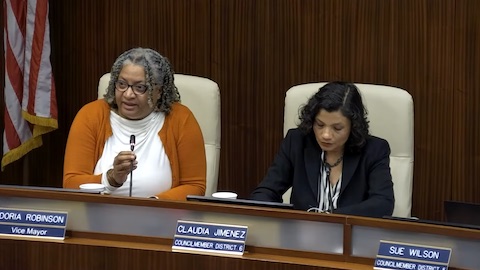
Richmond City Council members Doria Robinson, left, and Claudia Jimenez authored a recommendation, which was approved Tuesday, that Richmond come up with a potential ICE-free zone ordinance. (Screenshot by Samantha Kennedy / The CC Pulse)
By Samantha Kennedy
Richmond is poised to add to its protections for immigrants after City Council members asked staff to start the process to bring a proposed ordinance to ban immigration enforcement activities on city property.
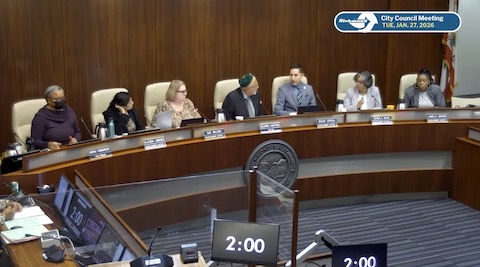
The measure that passed Tuesday, with the support of six members and council member Jamelia Brown abstaining, directs City Manager Shasa Curl and City Attorney Shannon Moore to give a report March 3 on current and planned efforts regarding federal immigration enforcement. Staff will then come back with an ICE-free ordinance proposal in 45 days.
“We’ve been seeing across the nation what’s happening in different cities, from Minneapolis to Chicago to [Los Angeles], and if we don’t have some type of planning, we can find ourselves in a really difficult situation,” said Vice Mayor Doria Robinson.
Council also requested that city staff bring forward emergency planning components, which would mean rapid public notifications in the event of immigration enforcement activity.
Widespread federal immigration enforcement and the often-illegal deployment of state National Guards in cities has spurred protests nationwide against the Immigration and Customs Enforcement agency since President Donald Trump took office last year. The killings of two U.S. citizens, Renee Goode and Alex Pretti, by ICE agents in separate incidents prompted additional, larger protests.
The Bay Area and Richmond itself have not seen the same level of enforcement as Los Angeles or Minneapolis, and the region successfully staved off a planned surge last fall, but council member Claudia Jimenez, who co-sponsored the item with Robinson, said that “there is a lot of fear” and misinformation.
“We need to really make sure that we as a city are taking [on] a [leadership] role to communicate what is happening in the community,” added Jimenez.
Already a sanctuary city and having spent $1 million on immigration legal support, Jimenez said that an ICE-free ordinance would differ from a sanctuary policy because it explicitly makes city property off limits to federal immigration enforcement activity.
Brown, who said she fully supported protecting immigrant communities and didn’t oppose ICE-free zones, was concerned that the ordinance could create fear and false expectations.
“I want to understand more on what we can legally do versus selling something to the community that’s not even true,” said Brown.
Brown added that the components bundled together instead needed to be evaluated on their own.
Earlier in the discussion, Robinson questioned what the ordinance would mean in the face of an administration that has already ignored laws in place.
“Minnesota is really facing that right now: How do they maintain rule of law when the federal government is lawless?” said Robinson.
Though other cities like Pinole and Oakland and the counties of Alameda and Santa Clara have enacted their own ICE-free zone ordinances, some experts and officials have questioned their reach.
Moore said that she needs more specifics to evaluate what an ICE-free zone would look like and how it would interact with the current sanctuary city policy.
Overall, community members spoke in favor of moving along with the plan to fill in what they saw as gaps in current policies.
“Right now, we have the opportunity to get ahead of this and to be prepared rather than reactive,” said Katherine Lee, a youth organizer with the Asian Pacific Environmental Network.



No Comments