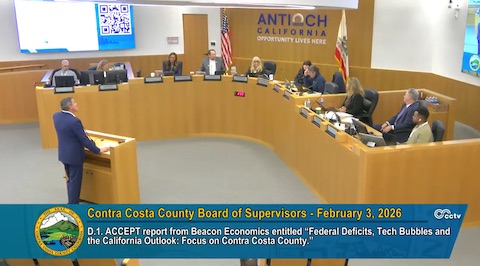
Antioch City Hall hosted the Contra Costa County Board of Supervisors meeting on Feb. 3. (Screenshot captured by Samantha Kennedy / The CC Pulse)
By Samantha Kennedy
As the county looks to grapple with the impact of the so-called “Big Beautiful Bill” on safety net programs and varying economic narratives, one economist says growth in Contra Costa is possible.
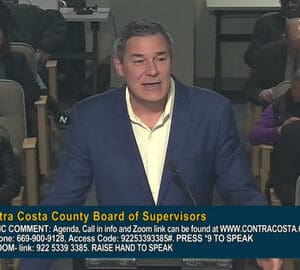
During a retreat Feb. 3, county supervisors met at Antioch City Hall to hear a number of presentations on the local and federal economic outlook that are meant to help inform policy decisions. Christopher Thornberg, an economist with Beacon Economics who presented one, said the thing getting in the way of the state and county growing is itself.
“The county’s inability to grow is what’s holding your economic potential back. We all know what’s causing this: It’s a lack of housing, period,” said Thornberg.
Between 2019 and 2024, residential permits across the state dropped by more than 8,650, said Thornberg. The drop in Contra Costa was 852, with the steepest decreases happening in unincorporated areas, Walnut Creek and Brentwood. Home sales too are “depressed.”
Thornberg said regulations on developers, rent control and other stabilization ordinances are getting in the way of growing housing, including affordable, to increase economic growth.
Antioch, Concord and Richmond have rent control or stabilization ordinances in place and so does the state, though Contra Costa does not. Officials in cities like San Pablo have previously refused to pass such policies, prompting residents to start their own efforts.
“How do you help renters? Well, how do you mess with landlords? Let them build whatever they want. By flooding the market with supply, that’s what ultimately makes housing affordable,” said Thornberg.
Thornberg said the traditional “filtering” process — where residents move from one residence to a newer one, leaving the one lower in price vacant for another to move into — is broken. That’s because residents are holding onto their homes because of prices.
He also pointed to the importance of workspaces, citing developments in the North Bay such as California Forever, as “the blueprint” for combining places to live and work to drive growth in the county.
“You have it all right there at your fingertips to build a new modern manufacturing hub,” he said.
Supervisor Shanelle Scales-Preston noted that while East County has seen significant housing development, it has not been matched with job growth.
Occupied office spaces decreased in the last year in the Antioch-Pittsburg area, along with the county, but with one of the lowest changes in the county. But Thornberg said that the county needs to move away from office space.
Earlier in his presentation, Thornberg said prices for essentials like food were not a major concern, that the economy “looks pretty good,” and that most residents are “doing quite well.”
Not everyone agreed with Thornberg’s analysis. Some residents said it was missing a human component.
“I hear statements like, ‘The people who live here are for the most part doing quite well.’ That narrative is not just false, it is harmful,” said Rachel Rosekind.
“It doesn’t mean people aren’t struggling,” Thornberg said in response to such comments. “But that said, a strong, growing economy with lots of job opportunities based around brand new housing developments with enormous industrial developments in this part of the world … is what will fix your budget.”
Related Posts:
Economist Says Closing County Refineries Would Be… An economist spoke to the Contra Costa County Board of Supervisors about the potential impacts of closing refineries, housing and wildfire preparedness.
Learning from the Past: SFPD Officers Gain New… Through the Sojourn Project, SFPD officers meet people connected to the civil rights movement to learn how that history relates to policing today.
We Belong Outdoors: Bay Area Groups Confront… The Bay Area's great outdoors often mirrors its difficult history of systemic inequality, revealing who gets access to nature and who doesn't.
We use cookies on our website to give you the most relevant experience by remembering your preferences and repeat visits. By clicking “Accept”, you consent to the use of ALL the cookies.
This website uses cookies to improve your experience while you navigate through the website. Out of these, the cookies that are categorized as necessary are stored on your browser as they are essential for the working of basic functionalities of the website. We also use third-party cookies that help us analyze and understand how you use this website. These cookies will be stored in your browser only with your consent. You also have the option to opt-out of these cookies. But opting out of some of these cookies may affect your browsing experience.
Necessary cookies are absolutely essential for the website to function properly. These cookies ensure basic functionalities and security features of the website, anonymously.
Cookie
Duration
Description
cookielawinfo-checbox-analytics
11 months
This cookie is set by GDPR Cookie Consent plugin. The cookie is used to store the user consent for the cookies in the category "Analytics".
cookielawinfo-checbox-functional
11 months
The cookie is set by GDPR cookie consent to record the user consent for the cookies in the category "Functional".
cookielawinfo-checbox-others
11 months
This cookie is set by GDPR Cookie Consent plugin. The cookie is used to store the user consent for the cookies in the category "Other.
cookielawinfo-checkbox-necessary
11 months
This cookie is set by GDPR Cookie Consent plugin. The cookies is used to store the user consent for the cookies in the category "Necessary".
cookielawinfo-checkbox-performance
11 months
This cookie is set by GDPR Cookie Consent plugin. The cookie is used to store the user consent for the cookies in the category "Performance".
viewed_cookie_policy
11 months
The cookie is set by the GDPR Cookie Consent plugin and is used to store whether or not user has consented to the use of cookies. It does not store any personal data.
Functional cookies help to perform certain functionalities like sharing the content of the website on social media platforms, collect feedbacks, and other third-party features.
Performance cookies are used to understand and analyze the key performance indexes of the website which helps in delivering a better user experience for the visitors.
Analytical cookies are used to understand how visitors interact with the website. These cookies help provide information on metrics the number of visitors, bounce rate, traffic source, etc.
Advertisement cookies are used to provide visitors with relevant ads and marketing campaigns. These cookies track visitors across websites and collect information to provide customized ads.






No Comments