After Wilbur Gary, a Navy veteran and American Legion post vice commander, wife Borece and their children moved into a Richmond home in 1952, 400 white men and boys gathered around their house to hurl rocks and insults.
By Steve Early
During World War II, the shipyard workforce in Richmond numbered 100,000 — and 20% was nonwhite. By 1945, Richmond had the largest public housing program in the nation, with 73,000 residents. Eighty percent of Richmond’s Black residents lived in these hastily constructed units but in racially segregated fashion.
As a “thank you” for their service building ships to defeat fascism in Germany and Japan, Richmond’s 14,000 African Americans became victims of renewed housing and job discrimination and wholesale displacement efforts, after the war.
The city’s federally funded projects became a major postwar battleground because of decisions made by the powerful, all-white Richmond Housing Authority. In the late 1940s and early 1950s, nonwhite public housing tenants were showered with eviction notices warning that their apartment buildings were about to be torn down.
The Richmond branch of the NAACP protested the demolition plans, arguing they were designed to push African Americans out of the city. Black tenants responded by signing petitions and attending mass meetings, picketing the RHA, and organizing rent strikes, all of which slowed the process. Nevertheless, by 1953, all 17 of the public housing projects near Richmond harbor had been dismantled.
Private housing options in the city were far more limited for Blacks than whites, as Navy veteran and American Legion post Vice Commander Wilbur Gary discovered.
He tried to move his wife, Borece, and their seven children from the Harbor Gate wartime housing project when it was scheduled for destruction. Their new home, purchased through a Black real estate agent, was located at 2821 Brook Way in a subdivision of 800 single-family homes called Rollingwood. During the war, it was a neighborhood almost exclusively occupied by white defense industry workers.
The Gary family was greeted by white racists who planted a KKK-style cross on their lawn. The downtown Richmond office window of their realtor, Neitha Williams, was shattered by a brick. On the night of March 7, 1952, after the family moved in, a menacing crowd of 400 white men and teenage boys gathered outside their new home to curse at them, hurl insults, and throw rocks.
A Lynch Mob in Richmond
The unruly mob ignored the county sheriff when he read parts of a U.S. Supreme Court decision outlawing restrictive covenants of the sort that white homeowners wrongly assumed would continue to protect them from new neighbors of the “wrong” color. The white protestors were similarly unmoved by the arrival of three white ministers who carried a U.S. flag and a copy of the Constitution. The sheriff’s department made no arrests and little effort to defuse the situation.
Fortunately, hundreds of Bay Area progressives, both Black and white, rushed to the scene that night — and for as long as it took thereafter — to defend the Gary family.
They formed a “human chain” around the house facing the screaming mob, in what became round-the-clock shifts. Among the first to arrive from Oakland was a key organizer of this fight, an immigrant from Britain whose activist career is now the subject of a new biography called “Troublemaker: The Fierce, Unruly, Life of Jessica Mitford” (Harper-Collins, 2025).
Written by literature professor Carla Kaplan, this book cites many other examples of Mitford’s exemplary 20th century solidarity with causes such as fighting fascism in Spain in the 1930s and saving the lives of unjustly convicted death row prisoners in the U.S.
According to Kaplan, Mitford — although coming from an extremely privileged background — was able to “transform herself into an engaged, effective ally because she sought others out who had reshaped their lives through personal sacrifice. She read. She listened.”
In the Cary case, her more experienced partner was Buddy Green, a fellow Communist Party member, military veteran, and leader of the East Bay branch of the left-wing Civil Rights Congress. As Kaplan reports, the CRC took a “a more activist approach to the fight for civil rights — not only in court but in the streets — to picket and do things that were considered, at the time, beneath the dignity of the NAACP.”
Green and Mitford’s hurried consultation with the besieged Gary family led to “a many-pronged approach: physical protection of the house, trade union resolutions demanding police protection, and distribution of leaflets, drawn up by the CRC, throughout the Bay Area.” While keeping its distance from the CRC, the Richmond NAACP mobilized its members, to join more radical out-of-towners. Eventually, two dozen white homeowners broke ranks. They wrote a letter welcoming the Gary family to their neighborhood, which Green and Mitford widely publicized.
Community and labor campaigners then demanded that the Richmond City Council ban segregation in post-war public housing. A special council session heard complaints about joblessness and other problems facing the city’s nonwhite residents. The city’s own discriminatory hiring practices came under fire. At the time, Richmond had no nonwhite firefighters and only two Black police officers.
Sounding the Alarm, Then and Now
As Kaplan argues, the successful defense of the Gary family showed the potential of “an inter-racial, cross-class, cross-gender coalition” capable of mobilizing at a moment’s notice — not unlike today’s emergency response efforts triggered by the appearance of uniformed thugs from Immigration and Customs Enforcement.
A decade after her involvement in Richmond’s most famous fair housing fight, Jessica Mitford became one of the leading “muckrakers” in America. In 1963, she published a best-selling book on widespread consumer rip-offs by the funeral industry. In “The American Way of Death” and many related articles, Mitford exposed “corrupt and predatory practices” that exploited millions of poor and working-class people after a death in their families. Her investigative journalism led to regulatory reforms and positive changes in funeral home behavior.
Pulse readers will find “Troublemaker” to be a long read (as in 581 pages’ worth). But the subject of this biography, who died in 1996, was a longtime maker of “good trouble,” whose exemplary activism is worthy of emulation by defenders of civil rights, civil liberties, and consumer protection in the East Bay today.
(Steve Early is a freelance journalist and labor activist who has lived in Richmond since 2012. He is the author of “Refinery Town: Big Oil, Big Money, and the Making of an American City” (Beacon Press, 2018), which tells this Richmond history story and others. He can be reached at Lsupport@aol.com.)
Related Posts:
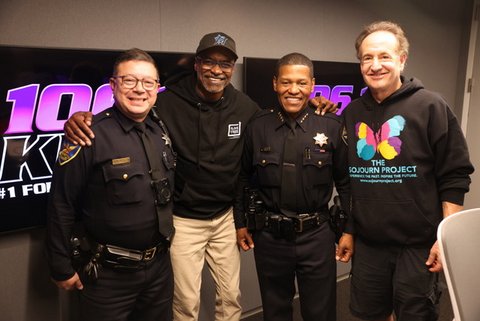
Learning from the Past: SFPD Officers Gain New… Through the Sojourn Project, SFPD officers meet people connected to the civil rights movement to learn how that history relates to policing today.
EdSource: Newsom Directs Agencies to Tackle… California is responding to loneliness and depression among boys and young men by trying to boost mental health support and educational and job opportunities.
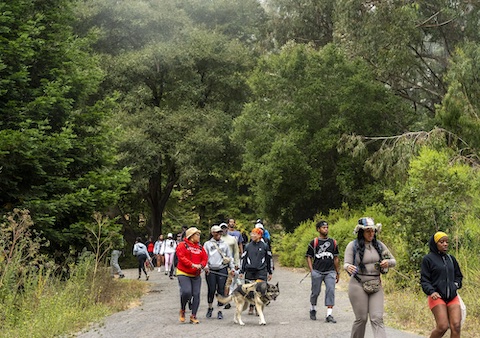
We Belong Outdoors: Bay Area Groups Confront… The Bay Area's great outdoors often mirrors its difficult history of systemic inequality, revealing who gets access to nature and who doesn't.
We use cookies on our website to give you the most relevant experience by remembering your preferences and repeat visits. By clicking “Accept”, you consent to the use of ALL the cookies.
This website uses cookies to improve your experience while you navigate through the website. Out of these, the cookies that are categorized as necessary are stored on your browser as they are essential for the working of basic functionalities of the website. We also use third-party cookies that help us analyze and understand how you use this website. These cookies will be stored in your browser only with your consent. You also have the option to opt-out of these cookies. But opting out of some of these cookies may affect your browsing experience.
Necessary cookies are absolutely essential for the website to function properly. These cookies ensure basic functionalities and security features of the website, anonymously.
Cookie
Duration
Description
cookielawinfo-checbox-analytics
11 months
This cookie is set by GDPR Cookie Consent plugin. The cookie is used to store the user consent for the cookies in the category "Analytics".
cookielawinfo-checbox-functional
11 months
The cookie is set by GDPR cookie consent to record the user consent for the cookies in the category "Functional".
cookielawinfo-checbox-others
11 months
This cookie is set by GDPR Cookie Consent plugin. The cookie is used to store the user consent for the cookies in the category "Other.
cookielawinfo-checkbox-necessary
11 months
This cookie is set by GDPR Cookie Consent plugin. The cookies is used to store the user consent for the cookies in the category "Necessary".
cookielawinfo-checkbox-performance
11 months
This cookie is set by GDPR Cookie Consent plugin. The cookie is used to store the user consent for the cookies in the category "Performance".
viewed_cookie_policy
11 months
The cookie is set by the GDPR Cookie Consent plugin and is used to store whether or not user has consented to the use of cookies. It does not store any personal data.
Functional cookies help to perform certain functionalities like sharing the content of the website on social media platforms, collect feedbacks, and other third-party features.
Performance cookies are used to understand and analyze the key performance indexes of the website which helps in delivering a better user experience for the visitors.
Analytical cookies are used to understand how visitors interact with the website. These cookies help provide information on metrics the number of visitors, bounce rate, traffic source, etc.
Advertisement cookies are used to provide visitors with relevant ads and marketing campaigns. These cookies track visitors across websites and collect information to provide customized ads.






No Comments