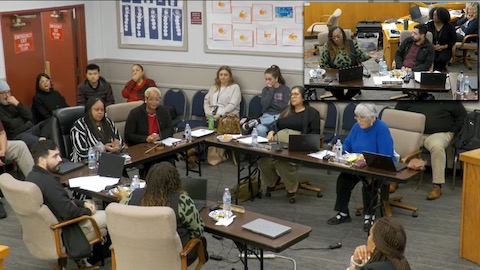
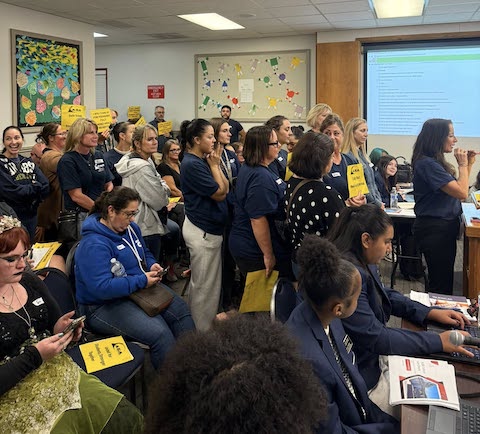
(Screenshot captured by Samantha Kennedy / The CC Pulse)
By Samantha Kennedy
The Antioch Unified School District has a budget problem. Or, as Contra Costa County Deputy Superintendent Daniela Parasidis calls it, a “now problem.”
That’s because the district must make around $30 million in cuts for the current and 2026-27 school years in the coming weeks, after doubling its deficit following the signing of labor agreements with district teachers and staff.
The district submitted a budget with a “positive” certification last year — which signals a school district will meet financial obligations in the current and following two years — but that was formally reduced to “qualified” status by the Contra Costa County Office of Education this month. The change means the county will now provide oversight of the district and offer other support to help it meet its financial responsibilities.
It also triggers the state’s Fiscal Crisis and Management Assistance Team to come in and perform an analysis identifying the district’s risk of insolvency.
“It’s important for the board and the community to understand that this process is based on a framework of progressive intervention,” Parasidis said at a special budget session of the Antioch school board on Wednesday. “The degree of oversight and support may change over time depending on the district’s actions and progress in addressing the identified fiscal concerns.”
Staff is expected to bring recommended cuts to the Feb. 18 school board meeting, where they’ll then need to be voted on by March 15.
Mike Fine, CEO of FCMAT, said he did not see anything from the board on Wednesday that led him to believe oversight would increase.
But he added that cuts by the deadline would be necessary.
“The bottom line is you cannot balance your budget with this size of a deficit without touching people, and we are a people business; we depend on people to serve people,” Fine said. “But that’s the reality.”
The change in certification also comes months after AUSD and unions representing teachers and other staff agreed to tentative agreements that included raises and better benefits. The agreements doubled the district’s deficit it was already facing. However, Fine said that board members were right not to blame employees for the deficit.
The $30 million multiyear deficit is “only the starting point,” according to Mia Cancio, director of fiscal services. The district’s enrollment is still declining, costs in special education and other staff are rising, and she said there is uncertainty in state funding.
There are a few steps the district has already taken to reduce the deficit.
In November, AUSD launched a campaign that aims for 95% average daily attendance. Six schools — the highest being Dozier-Libbey Medical High School — had ADA rates that were higher than both the district’s and the state’s.
And district officials are also exploring placing a parcel tax on the ballot this year that could be a source of flexible revenue to the district. Passing the potential parcel tax would require at least two-thirds of voters to approve.
Though still in the early stages, the tax could be on the ballot as soon as November.
Related Posts:
First Antioch School Board Raise in Years Comes With… Despite concerns about doing so while facing budget cuts, Antioch Unified School District board members are increasing their pay for the first time in decades.
AUSD Classified Staff Gets Raise, but Teachers Still… Maintenance and clerical workers and other classified staff in the Antioch Unified School District are getting a 1.5% raise and continued fully paid healthcare.
We use cookies on our website to give you the most relevant experience by remembering your preferences and repeat visits. By clicking “Accept”, you consent to the use of ALL the cookies.
This website uses cookies to improve your experience while you navigate through the website. Out of these, the cookies that are categorized as necessary are stored on your browser as they are essential for the working of basic functionalities of the website. We also use third-party cookies that help us analyze and understand how you use this website. These cookies will be stored in your browser only with your consent. You also have the option to opt-out of these cookies. But opting out of some of these cookies may affect your browsing experience.
Necessary cookies are absolutely essential for the website to function properly. These cookies ensure basic functionalities and security features of the website, anonymously.
Cookie
Duration
Description
cookielawinfo-checbox-analytics
11 months
This cookie is set by GDPR Cookie Consent plugin. The cookie is used to store the user consent for the cookies in the category "Analytics".
cookielawinfo-checbox-functional
11 months
The cookie is set by GDPR cookie consent to record the user consent for the cookies in the category "Functional".
cookielawinfo-checbox-others
11 months
This cookie is set by GDPR Cookie Consent plugin. The cookie is used to store the user consent for the cookies in the category "Other.
cookielawinfo-checkbox-necessary
11 months
This cookie is set by GDPR Cookie Consent plugin. The cookies is used to store the user consent for the cookies in the category "Necessary".
cookielawinfo-checkbox-performance
11 months
This cookie is set by GDPR Cookie Consent plugin. The cookie is used to store the user consent for the cookies in the category "Performance".
viewed_cookie_policy
11 months
The cookie is set by the GDPR Cookie Consent plugin and is used to store whether or not user has consented to the use of cookies. It does not store any personal data.
Functional cookies help to perform certain functionalities like sharing the content of the website on social media platforms, collect feedbacks, and other third-party features.
Performance cookies are used to understand and analyze the key performance indexes of the website which helps in delivering a better user experience for the visitors.
Analytical cookies are used to understand how visitors interact with the website. These cookies help provide information on metrics the number of visitors, bounce rate, traffic source, etc.
Advertisement cookies are used to provide visitors with relevant ads and marketing campaigns. These cookies track visitors across websites and collect information to provide customized ads.




No Comments