


17 Feb How Jesse Jackson Kept Hope Alive for Black Youth — and the Presidential Dream That Followed
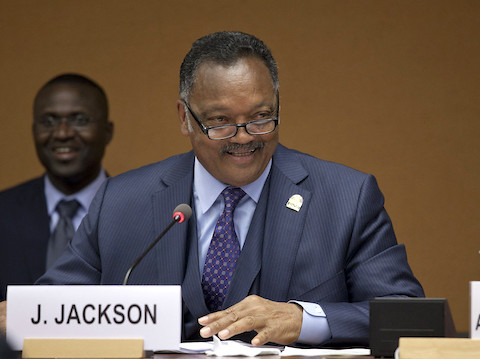
The Rev. Jesse Jackson speaking at the UN in 2012 marking the International Day for the Elimination of Racial Discrimination. (“Reverend Jesse Jackson spoke at the UN” by Eric Bridiers / United States Mission Geneva, CC BY-ND 2.0 via Flickr)
Commentary, N.C. Greene
American Community Media
“Hands that once picked cotton can now pick presidents.”
When the Rev. Jesse Jackson delivered those words during the 1984 Democratic National Convention and throughout his 1988 presidential campaign, he shifted how Black political participation was publicly imagined. He placed the descendants of enslaved laborers at the center of American democracy and spoke about power as something to be claimed rather than merely petitioned for.
Jackson, who died Feb. 17 at the age of 84, carried the moral authority of the Civil Rights Movement into a rapidly changing political and cultural era.
As the country moved through the Reagan years, widening economic divides and intensifying debates over urban policy, a new generation of Black Americans was coming of age. Hip-hop was emerging as both cultural force and political commentary. Global attention to apartheid and the eventual release of Nelson Mandela deepened international awareness within Black communities. Films such as “Do the Right Thing” and “Malcolm X” — amplified through the lens of Spike Lee — helped shape political identity through art.
Jackson spoke directly into that moment.
His presidential campaigns mobilized voters across racial and economic lines, building the Rainbow Coalition around economic justice, voting rights, labor, and human rights. He won primaries, amassed delegates, and demonstrated that a Black candidate could compete vigorously on a national stage. His campaign stops became civic classrooms, introducing policy conversations to communities that often felt overlooked in traditional political discourse.
What resonated most deeply with young African Americans was the way he sounded. His delivery carried the rhythm of the Black church and the cadence that felt culturally fluent in the hip-hop era. Politics did not feel distant when Jackson spoke; it felt accessible. He communicated with clarity and urgency, bringing governance into everyday conversation rather than leaving it confined to Washington.
That generational connection extended into popular culture. When Jackson appeared on “A Different World,” the “Cosby Show” spinoff centered on life at a fictional historically Black college, he stepped into a cultural institution shaping the political literacy of Black youth in the early 1990s. The series addressed apartheid, economic disparity, and civic engagement, and Jackson’s presence reinforced the idea that cultural identity and political responsibility moved together.
For many who grew up during that era, myself included, Jackson represented the first time they saw a Black presidential candidate command national attention with authority and competitiveness. Before the term “swag” entered popular vocabulary, Jackson embodied it — confidence grounded in conviction, style inseparable from substance.
America watched him debate policy, build coalitions, and energize crowds. Even those too young to grasp electoral mechanics understood the significance of visibility.
The Rev. Jesse Jackson marched with Martin Luther King Jr. and helped pave the way for the first Black president. When Barack Obama mounted his historic presidential campaign, it unfolded in a country that had already witnessed what was possible — and what would become reality.
The iconic civil rights leader’s death on February 17, 2026, left the nation in mourning, but his legacy endures with a charge that still resonates: “Keep Hope Alive.”


No Comments