


20 Feb Antioch Unified Budget Cuts Could Eliminate Hundreds of School Jobs
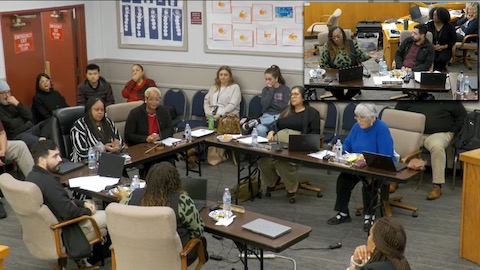
(Screenshot captured by Samantha Kennedy / The CC Pulse)
By Samantha Kennedy
In the same month Antioch Unified learned that the Contra Costa County Office of Education had downgraded its budget certification, the district is making moves to solve its approximately $30 million deficit.
But many community members say the proposed solution is the wrong one.
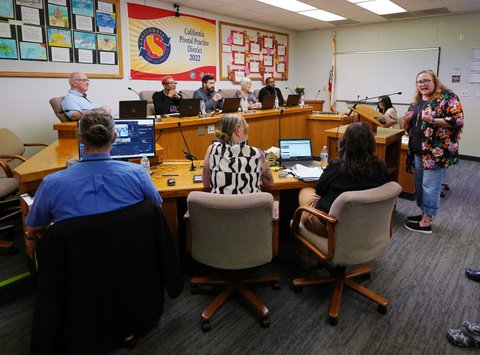
During a tense Wednesday meeting that included nearly three hours of public comment, school board members narrowly approved initial cuts to around 300 positions, many in special education, which reportedly could save AUSD upwards of $37 million.
“We’re not choosing whether we get rid of people or whether we cut centralized staff, whether we cut programming — all of that will have some amount of cuts,” said board member Antonio Hernandez. “What we’re trying to do here is preserve that choice that we have here as a community.”
In two 3-2 votes, members passed two resolutions that could allow cuts to the equivalent of 185.725 classified staff and 114 certificated staff. Layoff notices were approved for around 50 paraeducators, who support teachers and students in special education, 20 custodians and 35 teachers.
Hernandez and Superintendent Darnise Williams emphasized that the approval of the resolutions does not mean all listed positions will ultimately be eliminated. The district must still determine which positions will actually be cut, in addition to any other reductions that may be made.
Like many districts across the Bay Area, AUSD’s declining enrollment, expiration of one-time COVID funding and rising costs — including those related to special education programming — have largely been the cause of its multiyear deficit.
Districts in Pittsburg, West Contra Costa and San Francisco have also proposed or already made cuts to their budgets to remain financially solvent. After entering into new labor agreements, those districts anticipated more cuts.
AUSD officials projected during their first interim budget report that the deficit over two years was already $14.7 million. That deficit doubled after reaching a tentative agreement with the teachers’ union.
The deal is expected to cost $27.26 million over three years, according to the district. Prior to that tentative deal, AUSD dedicated over 76% of general funding — or about $248.9 million of a $321.6 million general fund — to salaries and benefits for employees, based on data from last summer’s preliminary budget.
Mike Fine, CEO of the Fiscal Crisis and Management Assistance Team, told board members at the Feb. 11 meeting that that share of funding is “very low.”
“That tells me for you, which is not usually the case, that you’ve got some non-personnel investments that are actually fairly substantial, and we would want to talk about those,” said Fine at that meeting.
On average, Fine said that about 85% to 90% of a district’s general fund goes toward staffing.
Special education positions make up large share of proposed cuts
The bulk of the approved cuts are to special education educator positions, which the district has struggled to staff.
In addition to the 50 paraeducators, the approved cuts include behavior support specialists, board certified behavior analysts, school psychologists, special education coordinators, a special education director and assistant director, special education coordinators, special education program specialists, a senior director and a special education technician.
District data shows that Antioch Unified employed 472 paraprofessionals during the 2024-25 school year. As of the beginning of the 2025-26 school year, the district reported at least eight paraeducator I vacancies and 16 paraeducator II vacancies, previous job postings show.
It remains unclear how many of the other positions approved for cuts may be vacant and otherwise covered by other contracted service providers, but some of the initial layoffs appear to eliminate the same amount of special education staff as those on the district’s publicly listed staff for its behavior team, special education leadership, and program specialists for elementary, middle and high schools.
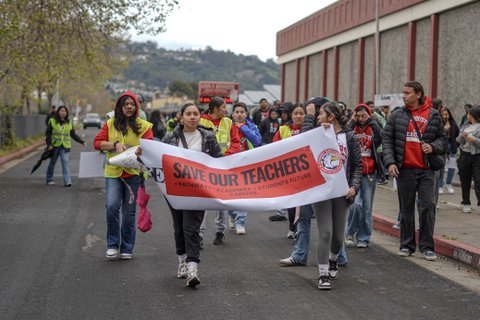
“If you take this away, you’re taking away their opportunities,” said parent Theresa Celestine. “They get connected to these paras. These paras become a part of their family.”
Barbara Holmes, a teacher at Turner Elementary School, said that the cuts to special education would also put student safety at risk.
“Our children will not be safe because in the event of a real emergency, we will be unable to get students out safely. We simply won’t have enough hands to do it,” said Holmes. “We won’t be able to manage things like tantrums or basic things like potty training.”
Board member Dee Brown voted against the cuts, though she acknowledged that cuts would have to be made. Brown, who has a daughter who uses district special education programming, said that she is “a mom first.”
“At the end of the day, I would be a silly, neglectful parent … if I stood here, knowing I have to face my baby girl [and make the cuts],” said Brown.
Hernandez said services required under students’ individualized education plans are still legally mandated.
“They are also entitled to that, and they will remain getting those services,” said Hernandez.
Across California, districts have filled those service gaps using contractors, who community members say often receive higher pay than special education staff that would be directly hired by the district.
Board member Mary Rocha, who voted against the cuts, said that she shared the same concerns about money going out and subcontractors.
“We need an audit report. We need an audit of the subcontractors that have been authorized,” said Rocha, also calling for a freeze on hiring high-level positions and travel.
District employees who may be affected by the cuts are expected to receive layoff notices by March 15.

No Comments