
25 Feb BART Sees Strong Start to 2026 With 4.6M January Trips, but Budget Crisis Persists
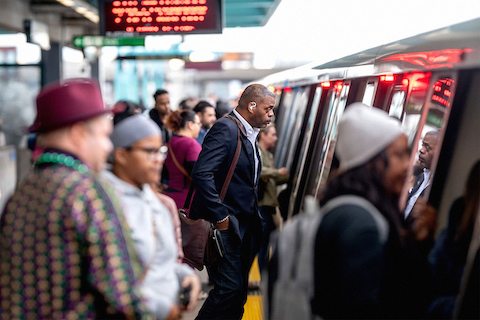
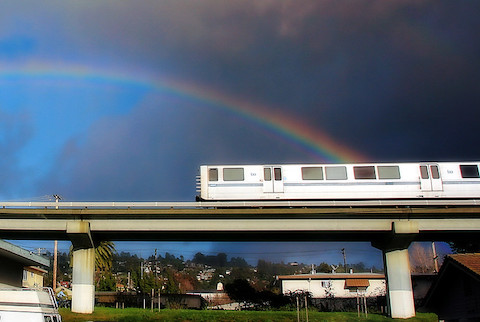
(Noah Berger / Metropolitan Transportation Commission via Bay City News)
By Bay City News
BART ridership continued its slow rebound in January with more riders returning to the rail system, even as the transit agency faces deep financial uncertainty, according to transit agency officials.
BART officials said Tuesday that based on data from their January 2026 Monthly Ridership Snapshot, there were nearly 4.6 million paid exits, which is a 10.7% increase compared with January 2025. Average weekday ridership reached 182,487 trips, and several weekdays topped 200,000 trips. The busiest day was Jan. 28, with 207,343 trips, according to the transit agency.
Ridership also spiked during major events. On Jan. 17, large crowds used BART to attend the Bob Weir public memorial in San Francisco’s Civic Center and a TWICE K-pop concert at the Oakland Arena. BART ran longer trains to handle the demand, agency officials said.
BART’s report also noted changes in how people are paying. Use of Tap and Ride — which allows riders to pay with contactless bank cards or mobile wallets — rose 15.5% in January compared with December. About 14% of all trips were taken using Tap and Ride. Clipper START, which offers a 50% discount for low-income riders, increased 32.6% year over year, transit officials said.
STILL MORE TO GO
Despite the positive trends, BART officials warned that ridership growth alone cannot close the agency’s funding gap. It remains far below its pre-pandemic ridership levels and agency officials say hybrid and remote work patterns continue to limit weekday commute trips, which historically have generated the most fare revenue.
While riders are returning, many are traveling less often.
The BART Board of Directors recently reviewed contingency plans in case a regional sales tax measure, called “Connect Bay Area,” fails to pass in November. The measure would raise the sales tax for 14 years in counties where BART operates to provide long-term funding for BART and other transit agencies.
Without new funding, BART faces annual deficits of more than $380 million through 2031, according to previous staff presentations. Even if the measure passes, the agency would still face annual shortfalls of at least $45 million.
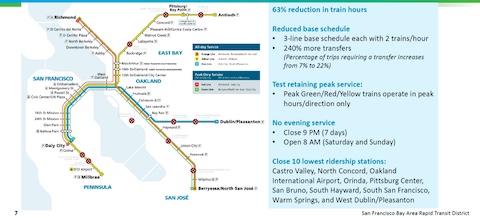
If the measure fails, staff outlined a two-phase plan that could close up to 15 stations, eliminate night service, cut up to 70% of operating hours and raise fares by as much as 50%. In the worst-case scenario, BART could shut down entirely if it cannot balance its budget, according to transit officials.
The agency is also relying on a short-term bridge loan from the state and the Metropolitan Transportation Commission to avoid an immediate $370 million budget gap in the next fiscal year, which begins July 1.
General Manager Robert Powers has told the BART board that without the sales tax measure, service reductions would be unavoidable.
“At the end of the day, if this measure isn’t successful, you know, stations are getting closed,” Powers said earlier this month. “There’s no two ways about that.”
For now, BART officials say steady ridership growth is encouraging. But they stress that a full financial recovery will depend not just on riders returning, but on securing long-term funding to stabilize the system.
Copyright © 2026 Bay City News, Inc. All rights reserved. Republication, rebroadcast or redistribution without the express written consent of Bay City News, Inc. is prohibited. Bay City News is a 24/7 news service covering the greater Bay Area.

No Comments