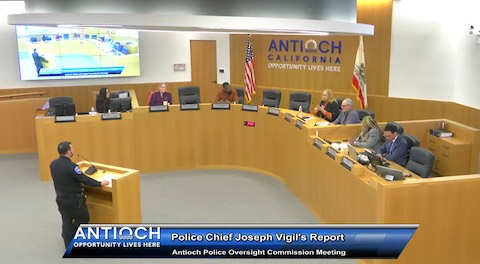
Questions of public safety versus privacy clashed Tuesday with a debate over police surveillance cameras at the Richmond City Council meeting. (Screenshot captured by Samantha Kennedy / The CC Pulse)
By Samantha Kennedy
Richmond City Council members delayed a vote Tuesday that would have decided how to move forward with automatic license plate reader cameras after hours of public debate over privacy and public safety.
Council members were expected to decide if the roughly 100 Flock Safety cameras should go back online. The cameras were turned off months ago because the Richmond Police Department was notified that the system was allowing limited searches from outside agencies because of a configuration error.
According to Police Chief Timothy Simmons, who spoke at the meeting, there was no evidence that any of the data was viewed by an outside agency.
After hearing about 50 public comments from supporters and opponents of the system, council members ended the meeting without taking a vote. A motion by council member Cesar Zepeda to continue the discussion Wednesday morning failed.
Simmons suggested two options for the Flock contract that expired Feb. 28: extend the city’s current contract with the company, including for the automated license plate reader cameras and other tools, or extend the contract without the ALPR cameras.
He recommended extending the contract with the cameras included.
“I firmly believe that there is a path forward where we can protect our residents from physical harm while also safeguarding their privacy and guarding against emotional harm and mistrust,” Simmons told council members.
Having the cameras, he said, could help with an active case involving a human trafficking victim.
The underage girl’s phone was pinging in the city while in a car, according to Simmons.
“If we had this technology up and running right now, we would know exactly where that car is right now,” said Simmons.
The ALPR system has resulted in 274 arrests from April 18, 2023, to Nov. 19, 2025, according to Simmons. In 2025, it resulted in 77 felony arrests and helped recover 61 stolen vehicles.
Since the cameras were turned off, Simmons said vehicle thefts have gone up by around 30%.
Opponents of the cameras raised privacy concerns and say the potential downsides of the system outweigh the benefits.
Flock Safety, which contracts with law enforcement agencies to provide ALPR cameras, CCTV and other products, has faced increasing criticism over reports that federal immigration authorities have been able to access data from its systems in the country.
As of early 2026, the company said that federal agencies are not part of state or national lookup networks for searches and do not share data with Immigration and Customs Enforcement.
But, regionally, Santa Clara County, Santa Cruz and Mountain View canceled their contracts with the company because of the privacy concerns.
Hope Dixon, a District 2 resident, had similar concerns.
“This is mass surveillance, and systems like this never stay limited to their original purpose. Right now, many of us do not trust the federal government, especially when it comes to immigration enforcement,” said Dixon. “We cannot safely build with a tool designed around data sharing.”
Mayor Eduardo Martinez said shortly before the end of the meeting that he didn’t think council members could trust Flock.
“That trust has been broken. That is a shame on Flock. If we choose to trust them again, and it
happens again, then that shame is on us as leaders of the community,” said Martinez.
Cities like Antioch, El Cerrito and Oakley still use Flock cameras despite concerns. El Cerrito Police Chief Paul Keith said that an audit recently found that two searches had been made by federal agencies: the U.S Postal Service and a veterans affairs police agency, according to NBC Bay Area. The Richmond Police Department says it only shares Flock data with the El Cerrito Police Department.
Sgt. Benjamin Therriault, president of the Richmond Police Officers Association, said that RPD had been operating with what he called one of “the most effective crime-fighting tools.”
“[The recommended action] restores the cameras temporarily while safeguards and oversight can continue,” said Therriault. “What is not balanced is allowing ideology to remove tools that help solve crimes, while our officers are already working with limited staffing and resources.”
Council member Jamelia Brown, who voted with council members Soheila Bana and Zepeda to finish the discussion Wednesday, wrote on social media that the issue should have been resolved that night.
“I will never forget the vote or the piercing feeling I was left with,” she wrote early Wednesday, referring to the missing girl mentioned in the meeting.
Richmond Ends Contract with Surveillance Agency… The Richmond Police Department’s contract with an automated license plate reader and face-recognition software company will expire after residents concerned about the company’s relationship with immigration authorities urged the city…
We use cookies on our website to give you the most relevant experience by remembering your preferences and repeat visits. By clicking “Accept”, you consent to the use of ALL the cookies.
This website uses cookies to improve your experience while you navigate through the website. Out of these, the cookies that are categorized as necessary are stored on your browser as they are essential for the working of basic functionalities of the website. We also use third-party cookies that help us analyze and understand how you use this website. These cookies will be stored in your browser only with your consent. You also have the option to opt-out of these cookies. But opting out of some of these cookies may affect your browsing experience.
Necessary cookies are absolutely essential for the website to function properly. These cookies ensure basic functionalities and security features of the website, anonymously.
Cookie
Duration
Description
cookielawinfo-checbox-analytics
11 months
This cookie is set by GDPR Cookie Consent plugin. The cookie is used to store the user consent for the cookies in the category "Analytics".
cookielawinfo-checbox-functional
11 months
The cookie is set by GDPR cookie consent to record the user consent for the cookies in the category "Functional".
cookielawinfo-checbox-others
11 months
This cookie is set by GDPR Cookie Consent plugin. The cookie is used to store the user consent for the cookies in the category "Other.
cookielawinfo-checkbox-necessary
11 months
This cookie is set by GDPR Cookie Consent plugin. The cookies is used to store the user consent for the cookies in the category "Necessary".
cookielawinfo-checkbox-performance
11 months
This cookie is set by GDPR Cookie Consent plugin. The cookie is used to store the user consent for the cookies in the category "Performance".
viewed_cookie_policy
11 months
The cookie is set by the GDPR Cookie Consent plugin and is used to store whether or not user has consented to the use of cookies. It does not store any personal data.
Functional cookies help to perform certain functionalities like sharing the content of the website on social media platforms, collect feedbacks, and other third-party features.
Performance cookies are used to understand and analyze the key performance indexes of the website which helps in delivering a better user experience for the visitors.
Analytical cookies are used to understand how visitors interact with the website. These cookies help provide information on metrics the number of visitors, bounce rate, traffic source, etc.
Advertisement cookies are used to provide visitors with relevant ads and marketing campaigns. These cookies track visitors across websites and collect information to provide customized ads.







No Comments