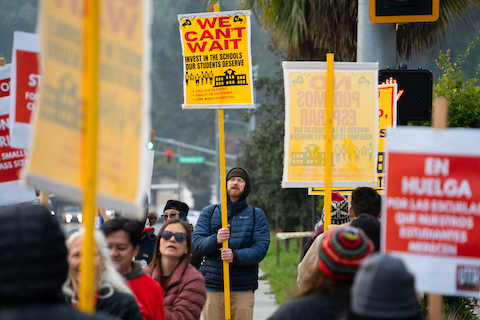
West Contra Costa Unified School District teachers and staff went on strike early last December, like multiple districts across the state. (Denis Perez-Bravo / CC Pulse file)
Teachers unions are demanding better pay and health benefits. Districts are pleading tight budgets. And students and parents are wondering: How will the tough choices ahead shape their schools’ futures?
That was the subject of an EdSource roundtable Thursday that brought together voices from around California, from a teacher in Sacramento County to a school board member in San Diego. The panel comes as unions in at least nine districts in California have authorized strikes — and as some districts contemplate school closures and layoffs amid financial pressures, including falling enrollment and rising insurance, utilities and special education costs.
While acknowledging limited budgets and frustration with state funding mechanisms, the panelists framed teacher pay and other classroom investments as complementary rather than competing objectives.
“If you’re working for what’s best for our students, cutting teachers is absolutely not the answer,” said Sabrina Bazzo, the vice president of the San Diego Unified School Board, which recently struck a tentative agreement on a new contract with teachers.
Michael H. Fine, the chief executive officer of the Fiscal Crisis & Management Assistance Team, said healthy reserves and prudent financial projections can absorb swings in state funding. But he warned that districts should remember that “our mission isn’t to save money” and that threatening layoffs makes it harder for teachers to focus on the classroom.
“You get a pink slip on March 15, the rest of the year’s morale is pretty darn low,” he said, “and it shifts focus despite (teachers’) great professional effort at that.”
What do teachers want from districts?
Teachers feel that budgets “have basically been balanced on their backs for years,” said David Goldberg, the president of the California Teachers Association. About a third of the association’s members report that they’re living paycheck to paycheck and are even delaying needed health care, he said. Teachers are “demanding that today’s dollars should be spent on today’s students” rather than saved in district reserves, he said.
Brittoni Ward, a teacher at Twin Rivers Unified School District in Sacramento County and president of Twin Rivers United Educators, said a colleague picked up a gig with DoorDash after school so that she could afford to buy a home.
Her union has been negotiating a contract for the past year so that teachers don’t “have to decide if they can buy groceries or go and get the EpiPen that they need for their child,” she said.
Ward said her district also needs smaller class sizes and more support for English language learners, foster youth and other groups of students. “We need to be doing so much more to put this money into the classroom to support these students,” she said.
How can districts prioritize spending?
Panelists largely agreed that paying teachers competitive wages and benefits should be a priority for school districts. But they noted that schools have much else to balance — from the goals outlined in three-year accountability plans to the rapidly climbing cost of liability coverage for sexual assault claims.
Under such constraints, Fine said, school districts must be transparent with teachers unions and their communities about the true cost of contract proposals, and the trade-offs to fund them.
“We end up making these deals and agreeing to terms a bit in the dark,” he said. “And I just think it’s wrong. I think it’s disingenuous to everybody involved. Some decisions require us to reprioritize. It’s as simple as that.”
How can districts handle rising special ed costs?
Special education is a growing source of financial pressure, panelists said, with special education students sometimes accounting for a larger share of the student body in districts with shrinking enrollment. Meanwhile, a lack of qualified educators working in special education has pushed some districts to hire contractors that are “half the quality of our employees and at double the cost,” Fine said.
Fine suggested that school administrators should seek creative solutions to that dilemma. “(For) every teacher that’s getting a layoff notice, why don’t we make a commitment to enroll them and pay to get a special ed credential?” he said.
Special education has also become a flash point in contract negotiations. At San Diego Unified, Bazzo said, the district avoided a one-day strike specifically organized around special education staffing, and has been able to reduce caseloads for some categories of educators and staff. “And we’ve been able to do that at the same time as providing 3-4% wage increases each year,” she said.
‘Unconscionable’: Union Remains Critical of WCCUSD… While the deal to end the WCCUSD teachers' strike awaits union approval to become official, some say they won't forget how the district handled negotiations.
We use cookies on our website to give you the most relevant experience by remembering your preferences and repeat visits. By clicking “Accept”, you consent to the use of ALL the cookies.
This website uses cookies to improve your experience while you navigate through the website. Out of these, the cookies that are categorized as necessary are stored on your browser as they are essential for the working of basic functionalities of the website. We also use third-party cookies that help us analyze and understand how you use this website. These cookies will be stored in your browser only with your consent. You also have the option to opt-out of these cookies. But opting out of some of these cookies may affect your browsing experience.
Necessary cookies are absolutely essential for the website to function properly. These cookies ensure basic functionalities and security features of the website, anonymously.
Cookie
Duration
Description
cookielawinfo-checbox-analytics
11 months
This cookie is set by GDPR Cookie Consent plugin. The cookie is used to store the user consent for the cookies in the category "Analytics".
cookielawinfo-checbox-functional
11 months
The cookie is set by GDPR cookie consent to record the user consent for the cookies in the category "Functional".
cookielawinfo-checbox-others
11 months
This cookie is set by GDPR Cookie Consent plugin. The cookie is used to store the user consent for the cookies in the category "Other.
cookielawinfo-checkbox-necessary
11 months
This cookie is set by GDPR Cookie Consent plugin. The cookies is used to store the user consent for the cookies in the category "Necessary".
cookielawinfo-checkbox-performance
11 months
This cookie is set by GDPR Cookie Consent plugin. The cookie is used to store the user consent for the cookies in the category "Performance".
viewed_cookie_policy
11 months
The cookie is set by the GDPR Cookie Consent plugin and is used to store whether or not user has consented to the use of cookies. It does not store any personal data.
Functional cookies help to perform certain functionalities like sharing the content of the website on social media platforms, collect feedbacks, and other third-party features.
Performance cookies are used to understand and analyze the key performance indexes of the website which helps in delivering a better user experience for the visitors.
Analytical cookies are used to understand how visitors interact with the website. These cookies help provide information on metrics the number of visitors, bounce rate, traffic source, etc.
Advertisement cookies are used to provide visitors with relevant ads and marketing campaigns. These cookies track visitors across websites and collect information to provide customized ads.




No Comments