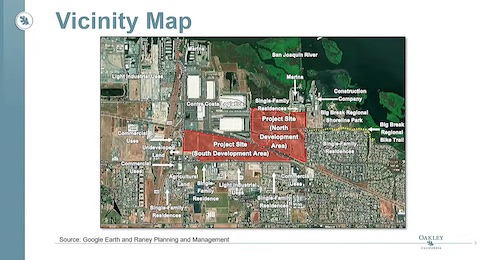
Oakley City Council members on Tuesday approved the Bridgehead Industrial Project after the possibility of it hosting an A.I. data center was removed. (Screenshot captured by Samantha Kennedy / The CC Pulse)
By Samantha Kennedy
A new project is coming to the city of Oakley, but it looks a little different than originally proposed.
City Council members on Tuesday approved the 164-acre Bridgehead Industrial Project, which is slated to include logistics buildings — but only after removing the possibility of artificial intelligence data centers from the project. Council member George Fuller was the lone vote against the project after dozens of public comments that lasted for hours.
Data centers were removed from the project after a request by Jason Bennett, a principal for JB2 Partners LLC, which is the developer and partner of applicant Oxfoot Oakley LLC.
“We have heard your concerns as a City Council, and we have certainly heard the concerns of the community, and — in line with the fact that it was never our principal strategy to develop data centers,” said Bennett, “I respectfully request to modify our application to remove data centers.”
Both Oxfoot Oakley and the vineyards are owned by Fred Cline.
The move drew applause from residents in the room. Council member Shannon Shaw later said that the change allowed her to support the project.
“I was not in any way ready to support this project with a data center in it. It wasn’t anything that my constituents were going to support,” said Shaw.
Stephany Salgado, who grew up in the city, said council members should consider a complete ban on data centers as residents said that the potential of housing any data center could mean high water and energy consumption.
“I get off the freeway, you see gas stations, storage places, property that’s untouched, the recycling center that’s empty and just boarded up,” said Salgado. “Is this what we really want to do to our city?”
Residents’ opposition to the project was contrasted by support from labor representatives and their workers. Citing the availability of nearby jobs that would cut their commutes down, union members said that the project would allow them to spend more time with their families and also benefit the industry.
Ramon Amaral, a field representative of the North Coast State’s Carpenters Union, said that over 300 carpenters live in Oakley.
“There are other people that would kill to work close to home,” said Amaral.
Like other East County cities, Oakley has some of the worst commutes in the state.
Project opponents, many also noting their long commutes, said that jobs and commute times shouldn’t be a reason to lend support.
“How can you justify approving a project that will have a long-lasting, permanent, negative effect on all of us just for temporary jobs?” said resident Jasper Willowbrook.
In explaining his opposition to the project, Fuller referred to concerns about air quality.
“[The other council members] are creating an environmental cesspool and forcing it onto the residents of Oakley,” said Fuller.
Planning commissioners gave the project, then with data centers, the initial approval it needed to go before the City Council back in January, but asked that additional requirements be added if a data center was later proposed.
Oakley Residents Push Against Project that Could… Residents rallied at an Oakley Planning Commission meeting in opposition to an AI data center that is being considered as part of a development project.
We use cookies on our website to give you the most relevant experience by remembering your preferences and repeat visits. By clicking “Accept”, you consent to the use of ALL the cookies.
This website uses cookies to improve your experience while you navigate through the website. Out of these, the cookies that are categorized as necessary are stored on your browser as they are essential for the working of basic functionalities of the website. We also use third-party cookies that help us analyze and understand how you use this website. These cookies will be stored in your browser only with your consent. You also have the option to opt-out of these cookies. But opting out of some of these cookies may affect your browsing experience.
Necessary cookies are absolutely essential for the website to function properly. These cookies ensure basic functionalities and security features of the website, anonymously.
Cookie
Duration
Description
cookielawinfo-checbox-analytics
11 months
This cookie is set by GDPR Cookie Consent plugin. The cookie is used to store the user consent for the cookies in the category "Analytics".
cookielawinfo-checbox-functional
11 months
The cookie is set by GDPR cookie consent to record the user consent for the cookies in the category "Functional".
cookielawinfo-checbox-others
11 months
This cookie is set by GDPR Cookie Consent plugin. The cookie is used to store the user consent for the cookies in the category "Other.
cookielawinfo-checkbox-necessary
11 months
This cookie is set by GDPR Cookie Consent plugin. The cookies is used to store the user consent for the cookies in the category "Necessary".
cookielawinfo-checkbox-performance
11 months
This cookie is set by GDPR Cookie Consent plugin. The cookie is used to store the user consent for the cookies in the category "Performance".
viewed_cookie_policy
11 months
The cookie is set by the GDPR Cookie Consent plugin and is used to store whether or not user has consented to the use of cookies. It does not store any personal data.
Functional cookies help to perform certain functionalities like sharing the content of the website on social media platforms, collect feedbacks, and other third-party features.
Performance cookies are used to understand and analyze the key performance indexes of the website which helps in delivering a better user experience for the visitors.
Analytical cookies are used to understand how visitors interact with the website. These cookies help provide information on metrics the number of visitors, bounce rate, traffic source, etc.
Advertisement cookies are used to provide visitors with relevant ads and marketing campaigns. These cookies track visitors across websites and collect information to provide customized ads.







No Comments