The Delta Bay church on Feb. 27 hosted the first Antioch Black Consciousness Conference and Concert, an event that is planned to be held annually. (Photo courtesy of Pablo Stone)
Commentary, Jasmine Ford
The first Antioch Black Consciousness Conference and Concert brought members of Antioch’s Black community together to discuss representation, healing and collective action.
Held at 40 Voices African American Holistic Wellness and Resource Hub at Delta Bay Church on Feb. 27, the gathering aimed to inform and encourage Black-owned businesses, community leaders and residents to organize and strategize about representation within the city.
Throughout the day, participants addressed a variety of issues affecting Antioch’s Black community, including mental health, education, policing, political representation, economic opportunity and faith leadership. Organizers said the conversations were intended to begin shaping a unified citywide Black agenda.
The conference began in the church sanctuary. The Rev. Lamont A. Francies Sr. and co-host Girared ”Gigi” Crowder spoke about the importance of representation within the community, and opened the floor up for questions and comments.
Some spoke about losing a family member, while others suggested that they would be willing to represent the community with help and assistance from churches and local Black businesses.
One moment that moved me was learning about the history of Antioch.
Antioch was once known as a sundown town, a place where people of color were discouraged or prevented from living or even visiting after dark. Over the last few decades, demographic changes have reshaped the city and shifted the legacy of exclusion in the area. Today, Antioch is home to about 22,000 Black residents, making it the largest Black population in Contra Costa County.
Despite Antioch’s growing Black population, many residents say they rarely see that reality reflected in city-sponsored events, leadership spaces or decision-making tables.
I believe some churches have, at times, turned their backs on each other in the name of defending what they believe is holy and right. Difference in doctrine and approach have created divisions that make it difficult for faith communities to unite and work together.
Meanwhile, a real crisis continues to unfold right in front of us, one that affects youth, families, and the broader community. Issues such as violence, economic hardship, and the need for stronger support systems require collective action, empathy and compassion. Moments like this gathering, remind us that the church has the opportunity and responsibility to rise above internal disagreements. By coming together, faith communities can recognize that the well-being of our city is shared and cannot be addressed in isolation.
Where does the representation of the Black community come from? That is why gatherings like this are important. To be seen, to feel heard, and to walk away inspired to inform the Black community that work is starting to be done.
During the conference, I also learned more about challenges facing the community that I am a part of.
About 8.5% of Black people in Antioch are unemployed; amongst that number are teens who have the highest unemployment rate.
Antioch has two Black women on the City Council, Monica Wilson and Tamisha Torres-Walker. Even still, we lack the representation and response to the issues we face in Antioch today.
Mental health was also a major topic of discussion.
Crowder, executive director of the National Alliance on Mental Illness of Contra Costa County, offered mental health resources for attendees
Black residents across the East Bay toil with racial trauma and discrimination, Crowder said, so creating safe spaces to talk about those experiences is important.
Another concern raised during the conference was the limited number of Black residents consistently speaking out against violence and advocating for recognition and change. With only a small group carrying that responsibility, burnout can quickly set in and slow the momentum of community efforts.
Participants also discussed how many events in Antioch are organized by people outside the Black community, which can make it harder to cultivate the sense of authenticity and cultural grounding that many local Black residents seek.
Part of the purpose of the gathering was to find out if there was a possibility to control these events; having a safe space for us to communicate, gather, and understand each other, without the overhead of control from the city.
Later in the event, we went into breakout groups. Black men and women were separated and brought into breakout dwellings.
I took part in a presentation by Lucretia Clark who said Black women and women of color were not just tired, but “HERstorically exhausted” from laboring in caregiving. Clark approached the presentation by speaking about how, as Black women, we can be exhausted from taking care of others and encouraged us to take care of ourselves.
At that moment, I felt seen.
Like many women, I have felt like I have had to take care of others first through communication, affection, prayer, and more.
“Caregiving can be exhausting. Being exhausted means that you are depressed,” Clark said.
She also discussed microaggressions in the workplace or daily life and scenarios to interpret that, as well as informed women that over-functioning in life is a survival pattern or strategy that we use to keep us going.
Overall, attendees at the conference were able to come together and fellowship, reflect, and encourage one another to get involved in the Antioch community, for the betterment of the Black community.
I was personally empowered to positively advocate for Antioch by giving voice to the voiceless and giving hope to those who have none.
Related Posts:
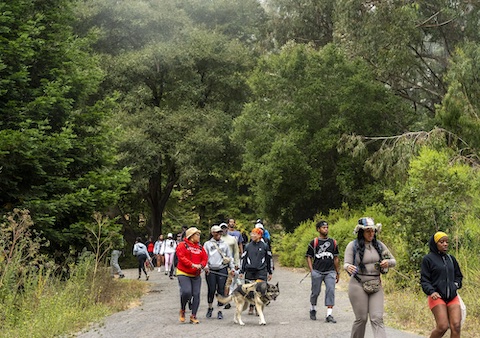
We Belong Outdoors: Bay Area Groups Confront… The Bay Area's great outdoors often mirrors its difficult history of systemic inequality, revealing who gets access to nature and who doesn't.
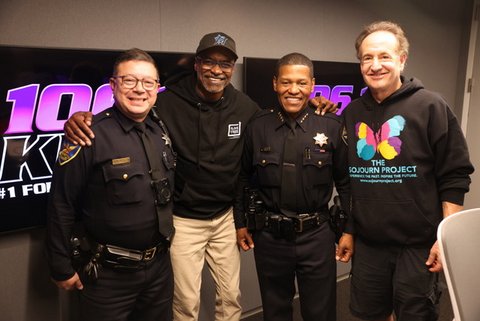
Learning from the Past: SFPD Officers Gain New… Through the Sojourn Project, SFPD officers meet people connected to the civil rights movement to learn how that history relates to policing today.
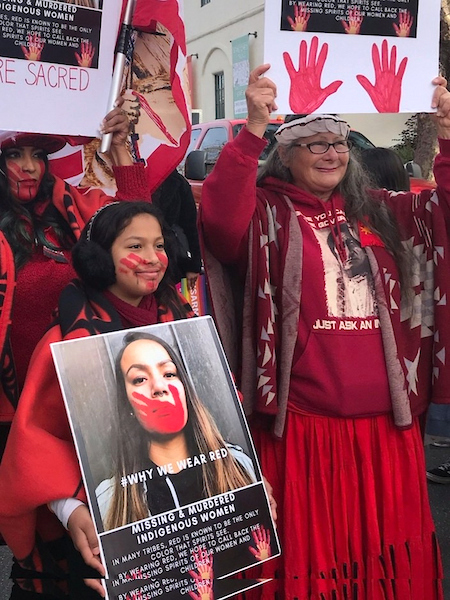
Organizers of Training on Missing and Murdered… Native organizers are working to educate California law enforcement about the Missing and Murdered Indigenous Persons crisis and resources to address it.
We use cookies on our website to give you the most relevant experience by remembering your preferences and repeat visits. By clicking “Accept”, you consent to the use of ALL the cookies.
This website uses cookies to improve your experience while you navigate through the website. Out of these, the cookies that are categorized as necessary are stored on your browser as they are essential for the working of basic functionalities of the website. We also use third-party cookies that help us analyze and understand how you use this website. These cookies will be stored in your browser only with your consent. You also have the option to opt-out of these cookies. But opting out of some of these cookies may affect your browsing experience.
Necessary cookies are absolutely essential for the website to function properly. These cookies ensure basic functionalities and security features of the website, anonymously.
Cookie
Duration
Description
cookielawinfo-checbox-analytics
11 months
This cookie is set by GDPR Cookie Consent plugin. The cookie is used to store the user consent for the cookies in the category "Analytics".
cookielawinfo-checbox-functional
11 months
The cookie is set by GDPR cookie consent to record the user consent for the cookies in the category "Functional".
cookielawinfo-checbox-others
11 months
This cookie is set by GDPR Cookie Consent plugin. The cookie is used to store the user consent for the cookies in the category "Other.
cookielawinfo-checkbox-necessary
11 months
This cookie is set by GDPR Cookie Consent plugin. The cookies is used to store the user consent for the cookies in the category "Necessary".
cookielawinfo-checkbox-performance
11 months
This cookie is set by GDPR Cookie Consent plugin. The cookie is used to store the user consent for the cookies in the category "Performance".
viewed_cookie_policy
11 months
The cookie is set by the GDPR Cookie Consent plugin and is used to store whether or not user has consented to the use of cookies. It does not store any personal data.
Functional cookies help to perform certain functionalities like sharing the content of the website on social media platforms, collect feedbacks, and other third-party features.
Performance cookies are used to understand and analyze the key performance indexes of the website which helps in delivering a better user experience for the visitors.
Analytical cookies are used to understand how visitors interact with the website. These cookies help provide information on metrics the number of visitors, bounce rate, traffic source, etc.
Advertisement cookies are used to provide visitors with relevant ads and marketing campaigns. These cookies track visitors across websites and collect information to provide customized ads.





No Comments